
When you encounter the term neti, you might be looking for a practical guide to nasal irrigation or exploring the profound philosophical depths of ancient Indian wisdom. Understanding the neti meaning requires looking at two distinct pathways: the physical cleansing technique rooted in Hatha Yoga and the meditative inquiry found in the Upanishads. Both carry the same name in Sanskrit, yet they serve entirely different purposes for the seeker.
Whether you are aiming to clear your sinuses or trying to peel back the layers of your own identity, knowing the context of this word is the first step toward effective application. This exploration will clarify these two sides of the same coin.
The Physical Practice of Nasal Cleansing

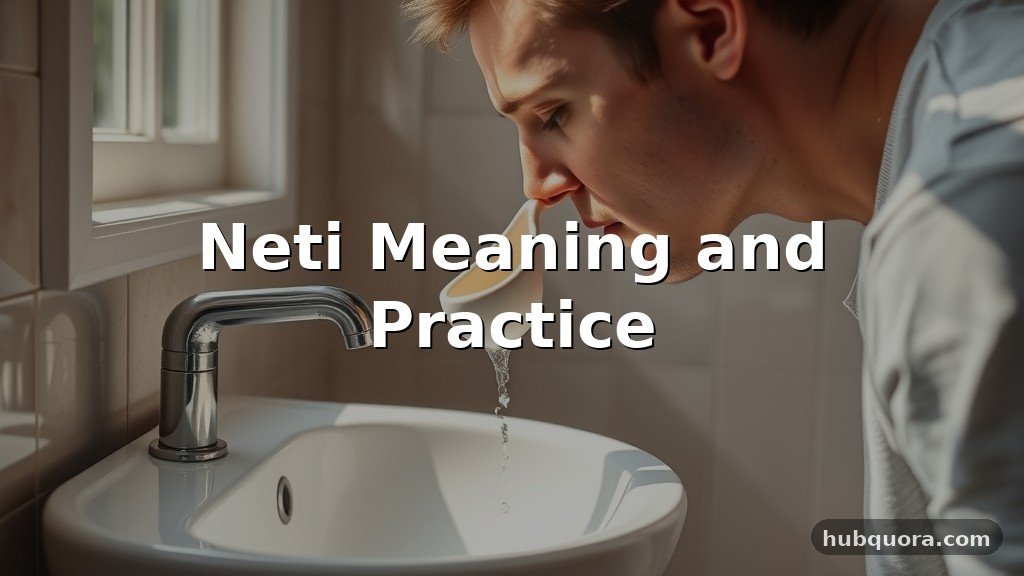
In the context of Hatha Yoga, the practice of neti is a form of Kriya, or internal purification. It involves the use of a specialized vessel, known as a neti pot, to pass saline solution through the nasal passages.
The primary objective here is to maintain hygiene, remove accumulated mucus, and improve respiratory efficiency. By flushing the nasal cavity, practitioners often find relief from seasonal allergies, congestion, and the general buildup of environmental pollutants.
The physiological impact of this technique is straightforward. By introducing a gentle flow of lukewarm, sterile saline, you effectively wash away irritants that settle in the mucous membranes. This is not merely about comfort; it is about respiratory health.
Many people find that incorporating this into their morning routine helps them breathe more freely throughout the day. If you are interested in the clinical perspective on these techniques, you can review the official guidance from the National Center for Complementary and Integrative Health regarding the safe use of nasal irrigation devices.
Exploring the Philosophical Neti Neti
The neti meaning shifts dramatically when you move from the bathroom to the meditation cushion. The phrase neti neti is a foundational concept in Advaita Vedanta, a school of Hindu philosophy. Translated from Sanskrit, it literally means “not this, not this.”
It is a method of negation used to describe the ultimate reality or the self. By systematically denying the labels, thoughts, and physical sensations that we usually identify with, the practitioner attempts to strip away the false ego.
This process is not an act of nihilism. Instead, it is a tool for discernment. If you ask yourself whether your body is your true self, the answer is “neti, neti”—it is not this, because the body changes and eventually fades.
If you look at your emotions or your passing thoughts, you apply the same logic. By saying “not this” to everything that is temporary, you are left with the awareness that remains. This awareness is the true subject, the witness that observes the world without being caught by it.
Origins in the Upanishads
The text that most famously highlights this concept is the Brihadaranyaka Upanishad. Within this ancient Sanskrit scripture, the sage Yajnavalkya guides his student through a rigorous process of inquiry.
The descriptions provided in the Upanishads are meant to push the seeker beyond the constraints of the mind and the physical world. It remains one of the most powerful intellectual exercises in spiritual history.
By using this negative definition, the ancient teachers realized that the absolute truth cannot be described using positive attributes. If you say “God is kind,” you have limited the concept to human definitions of kindness. If you say “God is powerful,” you have imposed a human scale of power.
By using “neti neti,” you avoid defining the infinite with finite words. It is an invitation to experience the truth directly rather than trying to grasp it with intellectual concepts.
Comparing Physical and Philosophical Contexts
It is helpful to keep these two definitions separate to avoid confusion. While they share a name, their functions in your life are distinct.
The physical practice addresses the needs of the body, while the philosophical inquiry addresses the needs of the consciousness. The following table highlights the key differences between these two interpretations of the word.
| Category | Physical Neti | Philosophical Neti Neti |
|---|---|---|
| Primary Domain | Hatha Yoga / Hygiene | Jnana Yoga / Philosophy |
| Goal | Nasal clearance | Self-realization |
| Tool | Neti pot and saline | Discernment and inquiry |
| Result | Better breathing | Clarity of awareness |
How to Approach the Meditative Inquiry
Starting a neti neti inquiry requires a quiet space and a commitment to radical honesty. You begin by sitting comfortably and observing your current state of being. You might notice a physical sensation, like tension in your shoulders, or an emotional state, like anxiety about the future.
You then mentally apply the negation. You acknowledge the sensation, but you declare that it is not your essential self.
This reflection can be challenging because we are so attached to our stories. We define ourselves by our jobs, our relationships, and our past mistakes. When you practice this, you are effectively loosening the grip these labels have on your psyche.
You are not trying to destroy your personality, but rather you are recognizing that the personality is an object of perception, not the witness itself. Over time, this creates a sense of detachment that allows you to act with more grace and less reactivity.
Safety Protocols for Nasal Irrigation
If you choose to engage in the physical practice, safety is paramount. The use of tap water is strictly discouraged because of the risk of rare but serious infections.
Always use distilled, sterile, or previously boiled and cooled water. The definition of a successful session is one where you feel refreshed, not one where you feel irritation or pain.
- Always ensure the saline solution is lukewarm to avoid shocking the delicate nasal tissues.
- Clean your neti pot thoroughly after every session to prevent bacterial growth.
- If you experience ear pain or significant discomfort, stop immediately and consult a healthcare professional.
- Maintain a consistent ratio of salt to water to ensure the solution is isotonic and non-irritating.
- Avoid sharing your equipment with others to maintain proper hygiene standards.
The Role of the Senses
In both the physical and the philosophical realms, the senses play a central role. In the physical practice, we are caring for the sensory gateway of smell.
In the philosophical practice, we are learning to observe the data coming through our senses without becoming enslaved by it. The mind is constantly receiving input, and we often confuse that input with our true nature.
When you practice the meditative version of this, you learn that the senses are just instruments. Your eyes see, but they are not the “seer.” Your ears hear, but they are not the “hearer.”
By separating the instrument from the operator, you gain a new perspective on how you interact with the world. This is the new way of seeing that the sages intended. It allows you to move through life with a sense of stability, regardless of what the senses are reporting.
Addressing Topical Gaps
Many resources focus exclusively on the physical pot or the philosophical mantra, leaving a gap for those who want to understand the linguistic and cultural bridge between them. The translation of the word itself is simple, but the evolution of its meaning across centuries is complex.
Some wonder if the two are related at all. Linguistically, they stem from the same root of “not” or “neither,” but they diverged into practical and abstract applications.
Another gap involves the “slang” or modern usage. In some circles, “neti” is used as a shorthand for the pot itself. It is important to clarify that this is a modern convenience rather than a traditional term.
The Oxford dictionary and other linguistic authorities focus on the traditional roots, but the cultural usage is far more fluid. By covering both the technical and the abstract, this article provides a complete picture that standard definitions often miss.
Integrating the Practice into Daily Life
You can integrate these concepts into your life without needing to become an ascetic or a yogi. For the physical side, keep your equipment clean and use it when you feel congested or exposed to high levels of dust.
For the philosophical side, use the negation technique whenever you feel overwhelmed by a specific emotion or identity crisis. When you feel “I am angry,” gently remind yourself that anger is a temporary state, not your permanent essence.
This dual approach creates a balance between the body and the spirit. You are not ignoring the physical vessel; you are maintaining it. You are not ignoring the mental state; you are observing it.
By keeping this balance, you ensure that your journey toward self-awareness is grounded in a healthy, functioning body. It is a holistic way of living that respects both the biological and the transcendental aspects of being human.
Common Misconceptions
A common error is believing that this is a religious practice that requires a specific set of beliefs. In reality, it is a methodology.
You do not need to subscribe to any particular dogma to benefit from nasal irrigation, and you do not need to be a monk to benefit from the meditative inquiry. The identity of the practitioner is irrelevant; the efficacy of the method is what matters.
Another misconception is that the goal of the inquiry is to become a “blank slate” or to stop feeling emotions. This is incorrect. The goal is to develop a relationship with your emotions where you are the master, not the servant.
You still feel joy, sadness, and excitement, but you recognize them as passing weather patterns in the sky of your consciousness. The sky remains unchanged, no matter how intense the storm.
FAQ Section
Is neti a word in Scrabble?
Yes, neti is considered a valid word in most Scrabble dictionaries. It is recognized as a noun referring to the yogic practice of nasal cleansing, often associated with the use of a neti pot. Always check your local tournament dictionary for the most current status of the word.
What is the difference between neti and neti neti?
The physical practice of neti refers to nasal irrigation used for health and hygiene. The philosophical concept of neti neti is a meditative technique of negation used in the Upanishads to realize the true nature of the self by stripping away false identifications through inquiry.
Can I use regular tap water for my neti pot?
You should never use regular tap water for nasal irrigation. It can contain microscopic organisms that are dangerous when introduced into the nasal passages. Always use distilled, sterile, or water that has been boiled and fully cooled to ensure your practice remains safe and effective.
Is the neti practice considered religious?
While the practice has roots in ancient Indian traditions and the Upanishads, the physical act of nasal irrigation is widely practiced today as a secular health routine. The philosophical inquiry is a tool for self-reflection that can be utilized by anyone, regardless of their personal religious or spiritual background.
Closing Thoughts on the Meaning of Neti
The journey through the neti meaning reveals a fascinating intersection of ancient health wisdom and profound philosophical inquiry. By maintaining the physical body through cleansing and refining the mind through the practice of negation, you create a life that is both vibrant and centered. Whether you are clearing your sinuses with a pot or clearing your mental clutter with the neti neti mantra, you are engaging in a process of purification that has stood the test of time.
Take these tools and apply them with consistency, patience, and a sense of curiosity. As you continue to explore these techniques, you may find that the simple act of letting go of what is “not you” creates the necessary space for your true potential to shine through.

James Wilson is the founder and lead editor of HubQuora.com, where he covers the latest celebrity news, entertainment trends, viral gossip, and net worth stories. With a passion for pop culture and digital media, James delivers engaging, accurate, and up-to-date content that keeps readers informed about the world of celebrities, influencers, and entertainment industry buzz.