
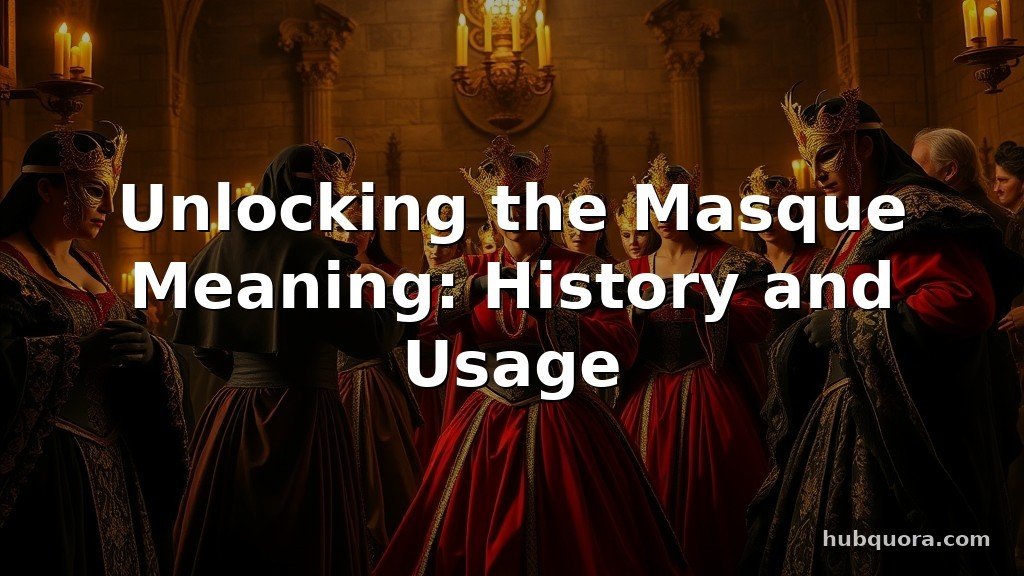
Understanding the specific masque meaning helps clarify why we distinguish between a simple facial covering and a complex historical performance. While the two terms are often used interchangeably in casual conversation, their roots diverge significantly in both literature and social history.
Exploring this distinction reveals a rich tapestry of cultural expression that spans from the elaborate courts of the Renaissance to modern beauty rituals. By examining these nuances, you will gain a clearer perspective on how language evolves and how a single word can encompass both high-art drama and everyday self-care.
The Historical Roots of the Masque
The term originates from the French word masque, which itself traces back to the Italian maschera. Historically, the masque was a specific type of courtly entertainment that flourished in Europe, particularly in England, during the 16th and 17th centuries.
Unlike a common theatrical play, these performances were highly stylized, involving music, dance, singing, and elaborate costumes. They were typically performed by masked courtiers before royalty, serving as a display of wealth, political influence, and artistic sophistication.
In this context, the masque meaning is tied to a blend of allegory and mythology. Participants would often perform in character, using the anonymity provided by their face coverings to engage in playful or symbolic interactions.
These events were exclusive, designed to flatter the monarch and reinforce the social hierarchy of the era. The performance was rarely a public affair; instead, it functioned as an intimate, private exhibition of status.
Distinguishing Between Masque and Mask
One of the most commonly confused pairs in the English language involves the spelling and usage of mask versus masque. While they share a common etymological ancestor, their modern applications occupy different linguistic spaces. A mask is generally understood as a noun representing a physical object used to cover or protect the face, whether for safety, disguise, or ritual.
In contrast, a masque is a specialized term. It functions primarily as a noun describing the performance art mentioned above, though it is also frequently used in the context of beauty and skincare. You will rarely find a situation where the two are truly interchangeable.
If you are referring to a piece of protective gear or a Halloween disguise, the correct term is always “mask.” If you are writing about a historical dramatic tradition or a deep-conditioning hair treatment, “masque” is the preferred spelling.
Navigating Confused Words in Contemporary Usage
The confusion often arises because the spelling “masque” feels more sophisticated or “French” to some writers. However, using it to describe a standard medical or costume mask is technically incorrect. The Merriam-Webster definition of the term reinforces its role as a dramatic entertainment or a cosmetic preparation.
When you encounter these confused words in literature, pay attention to the setting. If the text discusses a ball or a play, you are likely looking at the theatrical definition.
Masques in Literature and Drama
Throughout history, the masque served as a vital literary device. Famous playwrights such as Ben Jonson and William Shakespeare incorporated these elements into their works to bridge the gap between reality and fantasy.
In these scenes, characters would often remove their disguises to reveal their true identities, symbolizing a shift in the plot or a moment of moral clarity. This transition is a hallmark of the genre.
The structure of these performances usually followed a set pattern: an “anti-masque,” which represented chaos and disorder, followed by the main act, which restored harmony and order. This allegorical structure allowed playwrights to comment on current political events under the guise of mythology. By analyzing the masque meaning in these texts, readers can identify subtext regarding the power of the monarchy and the fragility of the social order during the Renaissance.
Evolution into Modern Skincare
Today, you are most likely to encounter the word in the beauty aisle. A hair or facial masque is a specialized cosmetic product designed for deep treatment.
Unlike a standard moisturizer or conditioner, these products are intended to be left on the skin or hair for a prolonged period, allowing active ingredients to penetrate deeply. The use of this term in the beauty industry borrows from the idea of “covering” or “masking” the face, but it elevates the concept to a ritualistic experience.
This shift in terminology highlights how marketing often adopts words that imply luxury and historical prestige. When a brand labels a product as a “masque” rather than a “mask,” it signals to the consumer that the item is a premium, intensive treatment rather than an everyday essential. The masque meaning in this sphere is thus tied to self-care, indulgence, and the temporary transformation of one’s appearance.
Common Synonyms and Related Concepts
When examining the synonyms for these terms, it becomes clear how much context dictates word choice. For a standard facial covering, synonyms include “visor,” “shield,” or “disguise.”
For the performance art, synonyms might include “pageant,” “revel,” or “entertainment.” Understanding these alternatives helps you avoid awkward phrasing in your writing.
| Context | Correct Term | Primary Function |
|---|---|---|
| Historical Theater | Masque | Allegorical performance |
| Skincare/Haircare | Masque | Deep conditioning treatment |
| Safety/Costume | Mask | Protection or concealment |
Addressing Common Topical Gaps
Many readers often ask if there is a difference in pronunciation. In modern English, both terms are usually pronounced identically, sounding like “mask.” The distinction is purely orthographic, meaning it exists only in writing.
Another gap involves the masque meaning in non-English speaking cultures. In French, for instance, masque is the standard term for both a physical mask and the theatrical performance, which explains why the distinction is more fluid in languages influenced by French.
Common Misconceptions
- Believing that “masque” is just a fancy spelling of “mask.”
- Assuming that all stage performances involving masks are technically masques.
- Thinking that the word is exclusively related to the 17th century.
- Overlooking the cosmetic industry’s intentional use of the term to imply luxury.
The Role of the Masquerade
It is impossible to discuss the masque meaning without touching upon the masquerade. A masquerade is a social event where guests wear masks, often in a grand, ballroom setting.
While the masque was a scripted performance, the masquerade was a participatory social activity. The two are closely linked, as the atmosphere of mystery and the breakdown of social barriers are central to both.
In a masquerade, the act of being masked allows individuals to behave in ways that would otherwise be socially unacceptable. This concept of the “masked self” has been a popular theme in literature, representing the idea that our true selves are often hidden behind the social roles we play. The masquerade provides the perfect setting to explore this duality, acting as a playground for identity exploration.
Linguistic Patterns and Dictionary Entries
When you look up a word in a standard English dictionary, you will often find multiple entries for the same spelling. The entry for masque is no exception. It serves as a prime example of how a noun can evolve across centuries, retaining its original dramatic definition while branching out into modern commercial applications.
For a learner of the English language, this can be challenging. It is important to look at the definitions provided in context.
If you are reading a historical novel, the meaning will differ significantly from a beauty magazine. Always check the surrounding sentences to ensure you are interpreting the word correctly, as context is the ultimate guide to semantic accuracy.
How to Use the Term Correctly
To ensure you are using the term appropriately, consider the intent behind your sentence. If you are describing a physical object, stick to “mask.”
If you are writing about a high-end beauty product, a historical courtly play, or an allegorical performance, “masque” is the correct choice. Using the wrong term can sometimes lead to confusion, especially in academic or professional writing where precision is valued.
Try to construct a masque sentence that clarifies the context immediately. For example, “The queen attended the evening masque, where dancers wore elaborate gold-leaf coverings.”
This sentence leaves no doubt that you are referring to the historical performance rather than a piece of personal protective equipment. By framing your sentences this way, you provide the reader with the necessary cues to understand your intended meaning.
The Cultural Significance of Concealment
Beyond the linguistics, the concept of the masque touches on the human fascination with concealment. Throughout history, we have used face coverings to transform, hide, or protect ourselves.
The masque as an art form allowed for a temporary suspension of reality. It invited the audience to step into a world where the laws of nature and social standing were suspended.
This desire to “see” beyond the surface is what keeps the concept of the masque relevant. Whether it is through the lens of a historical drama or the relaxing application of a facial treatment, the word continues to evoke a sense of mystery and intentionality. It represents a deliberate choice to step away from the mundane and engage with something more theatrical or restorative.
FAQ Section
Is there a difference between a masque and a mask?
Yes, the difference is primarily contextual. A mask is a physical object used for protection or disguise.
A masque is a historical type of courtly performance or a modern term for a deep-conditioning beauty treatment. In modern English, they are pronounced the same but used differently.
What does masque mean in literature?
In literature, a masque refers to a dramatic form popular in the 16th and 17th centuries. It combined music, dance, and poetry to present allegorical themes, often performed by masked courtiers to celebrate the monarch and reinforce the social order of the time.
Why do beauty brands use the spelling masque?
Beauty brands use “masque” to evoke a sense of luxury, history, and sophistication. The term suggests that the product is a specialized, intensive treatment that offers a transformative experience, distinguishing it from standard, everyday skincare or haircare products that might be labeled as masks.
Can I use the term masque for a surgical mask?
No, you should not use “masque” for a surgical or medical mask. That usage is technically incorrect and would be considered a misspelling. Always use “mask” when referring to protective equipment, as “masque” is reserved for artistic, historical, or cosmetic contexts.
Conclusion
Navigating the nuances of language often reveals how much our vocabulary is shaped by history, art, and commerce. While the masque meaning has shifted from the royal courts of the Renaissance to the modern vanity table, the core idea of an intentional, transformative covering remains intact. By distinguishing between these confused words, you improve your ability to communicate with precision and flair.
Whether you are analyzing a classic play or upgrading your skincare routine, knowing when to use each term adds a layer of clarity to your writing. I encourage you to observe how these words appear in your daily reading and notice the subtle ways context dictates their usage. If you have enjoyed exploring these linguistic layers, feel free to share your thoughts or ask further questions about how words evolve.

James Wilson is the founder and lead editor of HubQuora.com, where he covers the latest celebrity news, entertainment trends, viral gossip, and net worth stories. With a passion for pop culture and digital media, James delivers engaging, accurate, and up-to-date content that keeps readers informed about the world of celebrities, influencers, and entertainment industry buzz.