
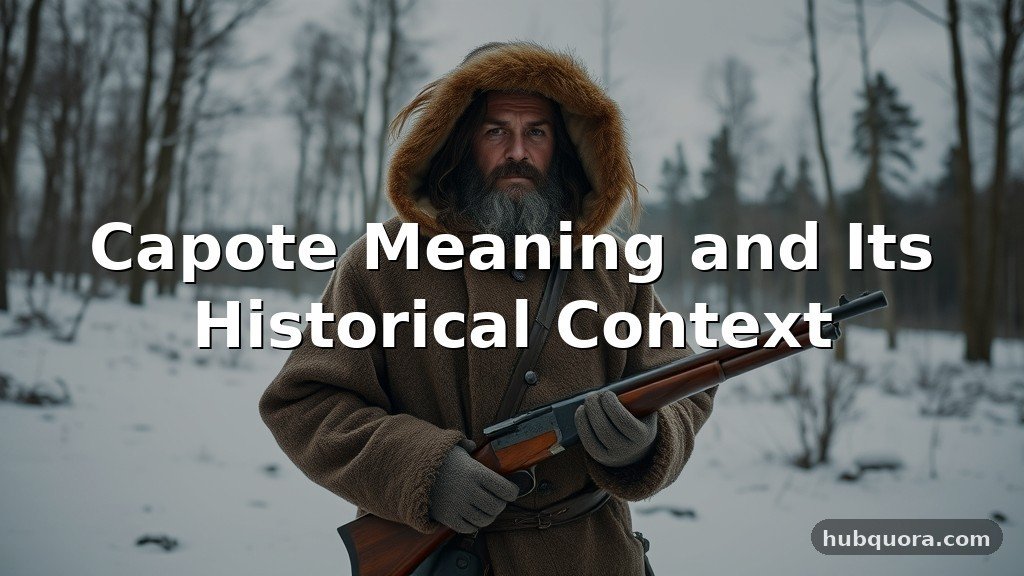
When you encounter the word capote, you might be looking at a term with several distinct layers of history and usage. At its core, the capote meaning often refers to a specific style of garment, though its etymology and application vary significantly depending on whether you are examining fashion history, linguistic roots, or even specific cultural traditions.
Understanding this term requires looking at how language evolves, as a word that once described a simple piece of utility clothing has transformed through centuries of use across different continents. You will find that tracing the evolution of this term reveals much about how we name the objects that protect us from the elements.
Exploring the various definitions helps clarify why this term remains relevant in modern discussions regarding historical attire and linguistic nuances. Whether you are curious about the French influence on the word or its application in North American frontier history, the term serves as a fascinating case study in semantic shifts. By breaking down its origins and practical applications, you can gain a clearer perspective on how this specific noun has persisted in our vocabulary.
The Historical Roots of the Capote

The term originates from the French word for a cloak, specifically one equipped with a hood. Historically, a capote was a long, heavy coat often made from wool blankets, which served as essential protection for explorers, fur traders, and indigenous populations in North America during the 18th and 19th centuries. Because it provided warmth during harsh winters, it became a staple of frontier life.
The construction of these garments was relatively straightforward but highly effective. Traders often repurposed trade blankets, folding and stitching them into a coat that was both durable and insulating.
This functional design meant that the capote was not merely a fashion statement but a vital tool for survival. As you look into the origins, you’ll find that the term essentially describes a long cloak designed for maximum coverage.
Linguistic Evolution and Dictionary Definitions
When you consult a resource like Merriam-Webster.com, you will see that the dictionary entry for this term highlights its role as a hooded cloak. The transition of the word from a French descriptor to a specific type of North American coat illustrates how vocabulary adapts to the needs of a new environment. Dictionaries often capture the primary definition, but the cultural weight behind the word is what truly defines its usage.
It is helpful to recognize that, while the term has a formal dictionary definition, its usage in literature and historical texts adds depth to its meaning. Authors who write about the fur trade or colonial history often use the word to evoke a specific sense of time and place. By grounding the term in its historical context, writers can immediately signal to the reader that they are dealing with a period-accurate setting.
The Capote as a Functional Garment
In practical terms, the garment was designed to be a coat that could withstand extreme cold. Unlike standard overcoats of the era, the capote was prized for its versatility.
The attached hood was a key feature, as it shielded the wearer’s head and neck from biting winds and driving snow. This design choice made it indispensable for those working outdoors.
The materials used were just as important as the design. Wool, specifically thick, felted wool, acted as a natural barrier against moisture and cold.
Even when wet, the wool maintained a level of warmth that synthetic alternatives of the time could not match. This reliability is why the garment remained popular for generations, serving as a primary defense against the elements in rugged landscapes.
Comparing Similar Outerwear
It is common to confuse this term with other types of historical outerwear. People frequently look for synonyms or related garments, such as capes, parkas, or greatcoats.
While they all serve the purpose of keeping the wearer warm, the specific construction of the capote sets it apart. The following table illustrates some of the key differences between these historical garments.
| Garment Type | Primary Feature | Historical Use |
|---|---|---|
| Capote | Hooded blanket-coat | Fur trade and exploration |
| Greatcoat | Structured, heavy wool | Military and formal wear |
| Cape | Sleeveless wrap | Ceremonial or aesthetic use |
| Parka | Insulated, windproof | Arctic survival |
Addressing Common Confusion
You might find that some people use the term interchangeably with other hooded wraps, leading to commonly confused concepts. In linguistic studies, these confused words often arise because of how language borrows terms across borders. Because the term entered English from French, it retained a specific connotation of a simple, utilitarian wrap.
When you encounter the word in a modern context, it is usually in a historical or vintage fashion discussion. It is rare to see the term used for modern, high-tech athletic gear, which illustrates how words can become “frozen” in time. If you are ever unsure of the precise usage, remembering the “hooded cloak” definition will almost always keep you on the right track.
Cultural Significance in North America
The garment played a significant role in the cross-cultural exchanges of the North American frontier. Indigenous peoples and European settlers both adopted the style, adapting the patterns to suit local materials and preferences.
This shared usage is a testament to the garment’s practicality. It served as a bridge between cultures, representing a shared need for survival in an unforgiving climate.
Beyond its utility, the item often featured distinct colors and patterns, particularly when made from Hudson’s Bay Company blankets. These iconic stripes were not just decorative; they identified the origin and quality of the wool. By wearing a specific style of capote, an individual could signal their status or their affiliation with a specific trade network, turning a simple coat into a complex sign of identity.
The Capote in Literature and Media
You will frequently encounter the term in historical fiction, particularly stories set during the era of the North American fur trade. Authors use the word to ground the reader in the reality of the 18th-century wilderness. Because it is a specific, evocative noun, it saves the writer from having to provide a lengthy description of the character’s clothing.
Using a precise term like this is a great way to show, rather than tell. Instead of explaining that a character is wearing a heavy, hooded, blanket-like garment to stay warm, the author simply uses the word, and the reader’s imagination fills in the rest. It is a powerful tool for maintaining the atmosphere of a story without stalling the narrative flow.
Topical Gaps and Clarifications
Many readers ask if the term has any modern slang applications. While there are niche uses in some dialects, the primary meaning remains tied to the historical garment.
Another common point of confusion involves the pronunciation. While it is derived from French, the anglicized version is generally pronounced “kuh-POHT,” with the emphasis on the second syllable.
It is also important to note that while the word is rarely used in daily conversation today, it remains a vital term for textile historians and museum curators. If you are researching historical reenactment, you will find that the word you’ll need to master is indeed this one. The list it’s part of is essentially a catalog of period-appropriate survival gear that defines the aesthetic of the era.
Identifying the Longest Long Words
While the term itself is not one of the longest long words in English, it fits into the category of vocabulary that describes specific, tangible objects. When you build a words list for historical research, you’ll find that many of the most descriptive terms are relatively short. These are not scorcher words meant to impress with their length, but rather precise tools for communication.
In the summer heat, you might not be thinking about winter coats, but understanding these terms is part of building a robust vocabulary. The words summer might bring to mind are usually lighter, but historical analysis requires that you look at the full spectrum of human experience, including the harsh winters that necessitated such heavy clothing.
Practical Next Steps for Enthusiasts
If you want to learn more about the craftsmanship behind these garments, the best approach is to visit a local history museum or explore archives dedicated to colonial history. Many such institutions have specific collections where you can see the construction details firsthand. You can also look for patterns if you are interested in making your own historical clothing.
Engaging with the history of the garment allows you to appreciate the transition from simple utility to cultural symbol. Whether you are a writer, a historian, or just a curious reader, understanding the context of the term adds a layer of richness to your knowledge of the past. As you continue your research, you will likely find that this one word opens the door to a much larger world of frontier history.
Frequently Asked Questions
Is capote a commonly used word in modern English?
No, it is not common in everyday speech. It is primarily used in historical contexts, literature, or when discussing specific types of vintage or traditional woolen garments. You will rarely hear it outside of a historical or academic setting.
How does the capote differ from a standard cloak?
The primary difference is functionality and construction. While a cloak is typically a loose, sleeveless wrap, a capote is specifically a hooded coat, often made from heavy, felted wool or blankets, designed for warmth and durability in cold environments.
Are there other meanings for the word capote?
In some contexts, particularly in French or specific regional dialects, it can refer to a hood or a covering. However, in English, the term is almost exclusively used to describe the historical hooded coat worn during the North American fur trade era.
What is the best way to pronounce capote?
In English, it is typically pronounced as “kuh-POHT.” The emphasis is placed on the second syllable, which aligns with its French etymology while conforming to standard English phonetic patterns. It is a straightforward word to say once you hear it in context.
The capote meaning is deeply intertwined with the history of exploration and the practical necessity of surviving the cold. By examining its roots as a hooded, blanket-based garment, you can see how language preserves the memory of past survival strategies. Whether you are encountering the term in a novel or a historical archive, you now have the context to understand its significance.
It serves as a reminder of how simple, functional objects can become enduring symbols of a specific time and place. If you have enjoyed exploring the history behind this word, consider visiting your local library or a regional historical society to see if they have any textile artifacts from the era of the fur trade. Exploring these physical connections is a fantastic way to deepen your understanding of the past.

James Wilson is the founder and lead editor of HubQuora.com, where he covers the latest celebrity news, entertainment trends, viral gossip, and net worth stories. With a passion for pop culture and digital media, James delivers engaging, accurate, and up-to-date content that keeps readers informed about the world of celebrities, influencers, and entertainment industry buzz.