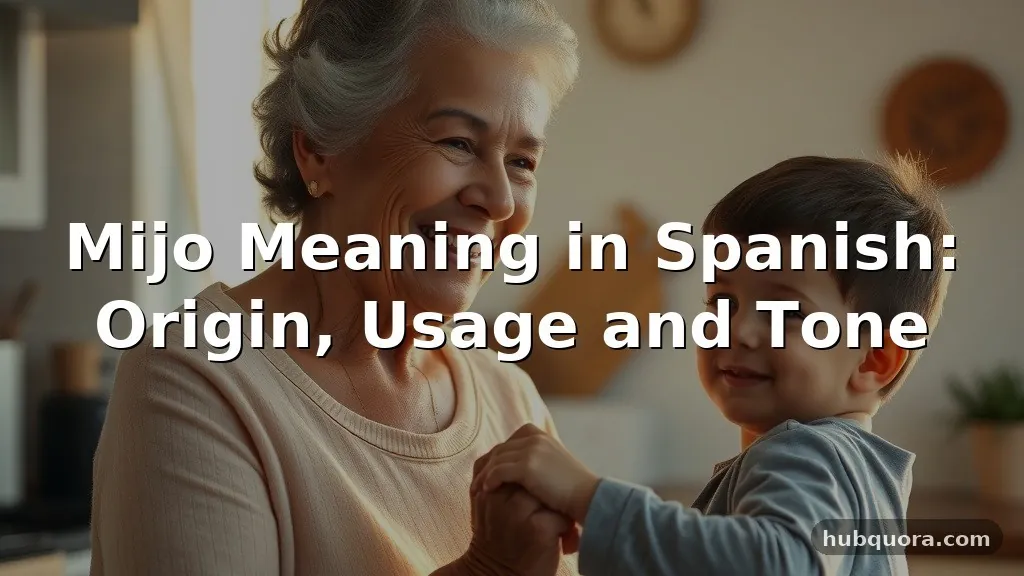
Mijo meaning is usually “my son” in Spanish, but the word often carries more warmth than its literal translation suggests. Spanish speakers may use mijo as an affectionate way to address a child, a younger person, a close friend, or someone who needs encouragement.
Depending on the speaker, relationship, age difference, country, and situation, it can sound caring, familiar, playful, protective, or occasionally flirtatious. It isn’t automatically romantic.
What Does Mijo Mean?

Mijo is an informal contraction of mi hijo, which literally means “my son.” The word combines mi, meaning “my,” with hijo, meaning “son.” In everyday speech, those two words commonly blend together: mi hijo becomes mijo. The feminine counterpart is mija, formed from mi hija, or “my daughter.”
The literal meaning explains the word’s origin, but it doesn’t cover every way people use it. A parent may say mijo to a male child, while an older relative may use it for a teenage boy or adult son.
A non-parent can also use the term as a warm form of address. In that setting, “my son” may be better understood as “dear,” “sweetie,” “kid,” or “my boy,” depending on the relationship.
Spanish speakers don’t always use family terms only for biological family. Words such as mijo and mija can express closeness, concern, social familiarity, or an age-based relationship. An older person might call a younger neighbor mijo without claiming a literal parent-child connection.
The meaning also changes with tone. A gentle “¿Cómo estás, mijo?” may sound caring.
A teasing “Ay, mijo, ¿qué hiciste?” might be playful or mildly exasperated. A dramatic “Mijo, listen to me” could signal advice from someone who sees the listener as younger or less experienced.
In English, there is no single translation that works in every case. “My son” is accurate in a family context, but “dear,” “buddy,” “young man,” or “sweetie” may communicate the social meaning more naturally in other situations.
Mijo and Mija: The Difference Between the Two
Mijo generally addresses a male, while mija generally addresses a female. The distinction comes from the grammatical gender of hijo and hija. Both forms can be affectionate, familiar, or protective, and neither word is limited to formal family relationships.
| Expression | Literal source | Usual gender reference | Common English sense |
|---|---|---|---|
| Mijo | Mi hijo | Male | My son, my boy, dear, kid |
| Mija | Mi hija | Female | My daughter, my girl, dear, sweetie |
| Hijo | Son | Male noun | Son |
| Hija | Daughter | Female noun | Daughter |
The word mija doesn’t necessarily mean that the person being addressed is a girl or a child. A mother could call her adult daughter mija, just as an older family friend might call a young adult woman mija. The speaker’s intention matters more than the person’s exact age.
Gender remains important, though. Calling a male person mija or a female person mijo may sound incorrect unless the speaker is joking, quoting someone, or using the word in an unusual way. Spanish nouns and familiar forms often preserve this male-female distinction even when the English translation does not.
Some speakers may also use these forms in ways shaped by local habits, family speech, or bilingual conversation. A person who grew up hearing mijo and mija may use them naturally with friends, coworkers, or younger peers.
Another Spanish speaker may reserve them for close family. Both patterns can be genuine.
Where Does the Word Mijo Come From?
Mijo comes from the spoken combination of mi hijo. Spanish frequently joins sounds in connected speech, especially in familiar conversation.
Over time, a phrase that is pronounced quickly can become a recognized informal form. In this case, the final vowel of mi and the beginning of hijo flow together, producing the sound represented in writing as mijo.
The origin is therefore straightforward: mijo does not begin as a completely separate word with an unrelated definition. It develops from a possessive expression plus a family noun. The same process explains mija, which comes from mi hija.
Spanish pronunciation helps explain why the contraction sounds natural. The letter j in hijo represents a strong breathy sound, similar to the sound in the Spanish word José.
The silent h at the beginning of hijo does not create a separate “h” sound. As a result, mijo is pronounced roughly “MEE-ho,” although the exact sound of the j varies across Spanish-speaking regions.
For learners, the distinction between mijo and mi hijo is useful. The longer form can sound more deliberate or literal, while the contracted form often feels more conversational.
That doesn’t mean the full phrase is formal or emotionally distant. A parent can use either form, but the rhythm and emphasis may change.
If you’d like to compare the pronunciation of related Spanish words, a reputable dictionary such as the Real Academia Española entry for “hijo” provides authoritative language information. The contraction itself is strongly associated with spoken, informal usage, so hearing it in context is often as valuable as studying its written form.
How People Use Mijo in Everyday Spanish
People use mijo in several social situations, and the surrounding words usually reveal the intended meaning. A mother might say, “Ven, mijo,” meaning “Come here, my son.” A grandmother may say, “¿Ya comiste, mijo?” as a caring question about whether the person has eaten. An older neighbor might use the same word with a younger man as a familiar form of address.
The expression can also soften advice or criticism. Consider these examples:
- “Mijo, ponte una chaqueta.” This may mean “Son, put on a jacket,” with a protective tone.
- “Ay, mijo, eso no se hace.” This can mean “Oh, dear, you shouldn’t do that,” combining affection with correction.
- “¿Qué pasó, mijo?” This may express concern, curiosity, or emotional support.
- “Mijo, tranquilo.” This often means “Easy, my boy” or “Calm down, dear.”
- “Gracias, mijo.” Depending on the speaker, this can sound like “Thanks, son,” “Thanks, dear,” or “Thanks, kid.”
The word can appear at the beginning or end of a sentence. Placement doesn’t create a fixed new meaning, but it can affect emphasis. “Mijo, ven acá” directly calls for attention. “Ven acá, mijo” may sound slightly softer or more conversational.
Family relationships are the clearest context. Parents, grandparents, aunts, uncles, and older siblings may use the term naturally.
Yet family language often extends beyond the household. A respected older person may call a younger community member mijo, especially when offering help or guidance.
In some cases, the term may sound patronizing if the relationship doesn’t support it. A stranger who uses mijo toward an adult man could appear overly familiar, depending on tone and cultural setting.
The same word from a trusted older woman might feel warm; from an unfriendly person, it could sound dismissive. Context does the heavy lifting.
Is Mijo Flirting or a Romantic Nickname?
Mijo is not automatically flirting. The word usually signals affection, familiarity, or a family-like relationship rather than romantic interest. A girl calling a man mijo may simply be using a friendly Spanish term, especially if she speaks that way with several friends or younger people.
Romantic meaning is possible, but the word alone cannot prove it. Couples sometimes borrow family-style expressions and affectionate nicknames, and a person may use mijo playfully with someone they like. Still, listeners should consider the entire interaction instead of treating one word as a hidden confession.
Look at the surrounding behavior:
- Does the speaker use mijo with everyone, or only with one person?
- Does the conversation contain obvious romantic teasing or personal compliments?
- Is the speaker older and using the word in a caring, almost parental way?
- Does the speaker use mija or similar terms with other friends?
- What happens before and after the word is said?
A text message such as “Buenas noches, mijo” could be affectionate, maternal, joking, or romantic. Without more information, it has no single certain interpretation. The speaker’s personality and regional speech habits matter as much as the dictionary definition.
In English-speaking online spaces, people sometimes assume that any affectionate Spanish word must be flirtatious. That assumption causes confusion.
Spanish speakers regularly use terms of endearment among relatives, friends, older and younger peers, and members of a close community. Warmth is not the same thing as romantic attraction.
Watch for consistency rather than overanalyzing
If you’re unsure, watch for consistency rather than overanalyzing one message. If the person uses the same term with many people, it probably reflects their normal speech.
If the word appears alongside clearly romantic behavior, it may carry an additional personal meaning. Asking politely can also be better than guessing.
Does Mijo Sound Different Across Countries and Communities?

Yes. Spanish is spoken across many countries, and vocabulary, pronunciation, and social habits vary by region. The core meaning of mijo remains connected to “my son,” but the word’s frequency and emotional tone can differ between families and communities.
In one place, mijo may be especially common among parents and grandparents. In another, it may be heard more often as a general term for a younger male. Some speakers may prefer the full phrase mi hijo, while others use the contracted form constantly in casual conversation.
Pronunciation also changes slightly. The Spanish j can sound stronger or softer depending on regional speech.
A listener who learned Spanish in one country may hear a familiar word pronounced differently elsewhere and assume it is a different term. Usually, it is simply an accent variation.
Social setting matters alongside geography. A person may use mijo at home but avoid it at work. Another speaker may use it with customers, neighbors, or younger acquaintances because it is part of their everyday style.
Age also influences usage. Older speakers may use family terms more freely, while younger bilingual speakers may use them humorously, ironically, or in social media captions.
Online platforms have widened exposure to the term. A viewer may encounter mijo in a video, comment, song lyric, or meme and then apply one interpretation to every situation.
That approach is risky. Digital speech often exaggerates emotion, plays with regional identity, or removes the facial expression and voice that normally clarify intent.
The safest interpretation is broad: mijo
The safest interpretation is broad: mijo is an affectionate or familiar male form of address rooted in “my son.” To identify the precise tone, consider the speaker, audience, country or family background, and conversation around it.
Mijo in Spanish, English, Slang and Social Media
Searches for “mijo meaning in English” often reflect a translation problem. A literal translation is “my son,” but a natural translation can be “dear,” “son,” “my boy,” “kid,” or “sweetie.” Translators should choose the English equivalent that matches the relationship and emotional register.
The word can function as informal slang, although it isn’t slang in the same way as a secret code or crude expression. It is better described as a colloquial contraction and term of endearment. “Colloquial” means that it belongs primarily to relaxed, everyday speech rather than highly formal writing.
On TikTok and other social platforms, mijo may appear in captions aimed at a male audience, in jokes about parents, or in clips that imitate an older relative’s voice. A creator might say “mijo” to make advice sound humorous or dramatic.
Another might use it as an affectionate nickname for followers. The platform context can make the word appear more flirtatious or more comedic than it would in an ordinary family conversation.
Spelling can vary in casual digital writing. People may write mijo, mijo with punctuation, or use mi hijo for emphasis.
The spelling mijo is not the same as the unrelated crop name “millet,” which is sometimes called mijo in other language contexts. When interpreting a Spanish message, the surrounding sentence makes the intended sense clear.
Another point matters for learners: using mijo yourself can sound natural in some relationships but forced in others. A non-native speaker who calls every male acquaintance mijo may unintentionally sound overly familiar.
Listening first is wise. If family members or close friends use the term with you, you can usually understand it as a sign of comfort and affection.
How to Interpret Mijo in a Specific Conversation
To interpret mijo accurately, start with the literal relationship between the people. Is the speaker a parent, grandparent, aunt, teacher, neighbor, friend, or romantic partner? A mother addressing her son has a different purpose from a friend using the word in a playful text.
Next, examine the sentence. The phrase surrounding mijo often supplies the emotional clue. A question about food, health, travel, or safety usually suggests care.
A sentence containing teasing may signal humor. A serious warning may combine affection with authority.
Voice and body language are especially important in spoken Spanish. A warm smile, gentle pitch, and relaxed posture make the word sound affectionate.
A sharp tone or exaggerated pause can make it sarcastic, annoyed, or patronizing. Text removes those clues, so readers need to rely on the broader exchange.
It also helps to compare the speaker’s habits. If they call several male friends mijo, the term is probably a general friendly address.
If they use it only with one person, it may have a more personal meaning, although that still doesn’t guarantee flirting. A person may reserve affectionate language for a particularly close friend or younger peer without romantic intent.
When uncertainty remains, ask about the word without making the question accusatory. “I’ve heard you call me mijo—what does it mean to you?” invites clarification. The speaker may explain that they mean “my son,” “dear,” or simply “friend.” A direct, respectful question is more reliable than translating the term in isolation.
These clues can help distinguish common
These clues can help distinguish common interpretations:
| Context | Likely tone | Natural English interpretation |
|---|---|---|
| Parent speaking to a son | Family affection | My son |
| Older person speaking to a younger man | Caring or familiar | Dear, young man, my boy |
| Friend using it jokingly | Playful | Buddy, kid, my man |
| Romantic partner using it | Personal affection | Dear, babe, my love, depending on the couple |
| Stranger using it sharply | Overfamiliar or patronizing | Kid, sonny, young man |
Common Mistakes About the Meaning of Mijo
One common mistake is assuming that mijo always means the speaker is the listener’s parent. The expression comes from “my son,” but everyday language often extends family vocabulary to people outside the immediate family. An older woman may call a neighbor mijo without suggesting a literal family connection.
A second mistake is treating the word as definite proof of flirting. Some people use affectionate terms with friends, relatives, children, customers, or younger acquaintances. Romantic intent requires more evidence than one nickname.
A third mistake is ignoring gender. Mijo is normally associated with a male person, while mija is normally associated with a female person. The words are related, but they aren’t interchangeable in standard usage.
People also sometimes translate every instance as “son.” That translation is technically close to the origin, yet it may sound unnatural in English. If a grandmother says “Come here, mijo,” the emotional sense could be “Come here, dear.” Good interpretation preserves tone, not just vocabulary.
Finally, learners may use the term too broadly. A word that sounds friendly in one community may feel intrusive in another.
Pay attention to how native speakers use it, especially with strangers and adults. Familiar language works best when the relationship supports it.
Conclusion: The Practical Meaning of Mijo
Mijo literally comes from mi hijo, “my son,” and it usually addresses a male person. In real Spanish conversation, it can also mean “my boy,” “dear,” “sweetie,” or “kid.” Parents and relatives use it affectionately, while older speakers, friends, and romantic partners may use it in broader ways.
It isn’t automatically flirtatious. Tone, relationship, regional habits, and surrounding words determine the message.
Frequently Asked Questions About Mijo Meaning
Can I call my boyfriend mijo?
Yes, you can, if it feels natural in your relationship and he is comfortable with it. A romantic partner may use mijo as a playful or affectionate nickname. Still, it literally relates to “my son,” so some Spanish speakers may prefer terms such as amor, cariño, or a personal nickname.
What does it mean if a girl calls me mijo?
She may be expressing friendliness, affection, familiarity, or playful teasing. It doesn’t automatically mean she likes you romantically. Consider whether she uses the word with other friends, her age relative to yours, the surrounding conversation, and her overall behavior before deciding what she intends.
Why do Spanish speakers say mija?
Mija is the feminine counterpart to mijo and comes from mi hija, meaning “my daughter.” A parent may use it with a daughter, while an older person may address a younger woman as mija. It can convey care, familiarity, advice, or affection outside literal family relationships.
How do you pronounce mijo?
Mijo is pronounced approximately “MEE-ho.” The Spanish j has a breathy or raspy sound, and its exact quality varies by region. The initial h in hijo is silent. In fast speech, mijo flows naturally as one word from mi hijo.
Is mijo a Spanish slang word?
Mijo is an informal, colloquial contraction rather than secret or crude slang. It comes from mi hijo and often works as an affectionate form of address. Its English equivalent depends on context: “my son,” “dear,” “my boy,” “kid,” or “sweetie” may all fit different conversations.

James Wilson is the founder and lead editor of HubQuora.com, where he covers the latest celebrity news, entertainment trends, viral gossip, and net worth stories. With a passion for pop culture and digital media, James delivers engaging, accurate, and up-to-date content that keeps readers informed about the world of celebrities, influencers, and entertainment industry buzz.