
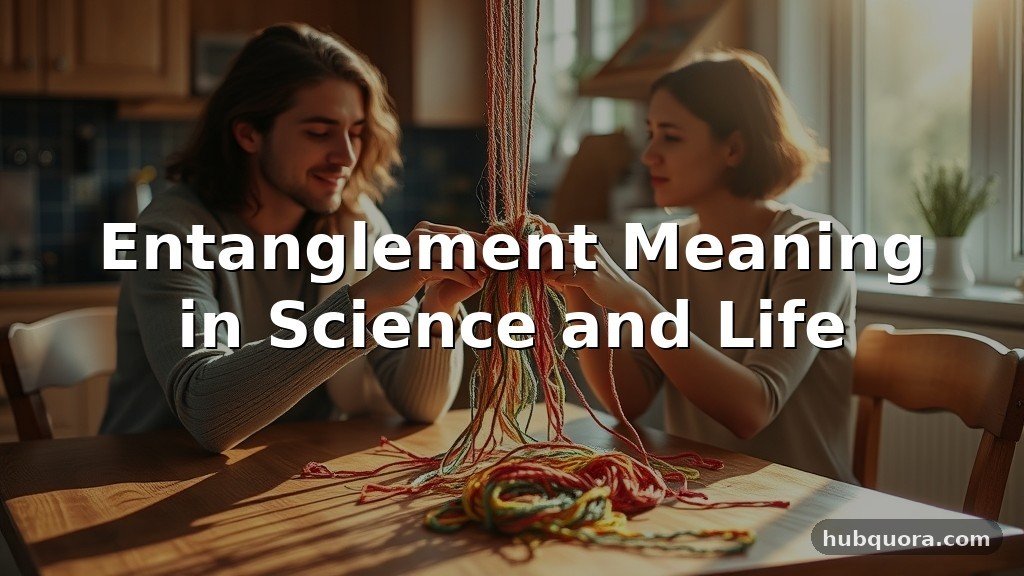
When you encounter the word entanglement, you might immediately think of a tangled knot of string or a complicated interpersonal situation. However, the term carries weight across vastly different fields, ranging from the abstract rules of physics to the messy reality of human connections.
Understanding the true entanglement meaning requires looking at how we use this word in everyday English while acknowledging its profound implications in scientific research. By exploring these distinct contexts, you will gain a clearer perspective on why this specific term appears in everything from academic papers to casual conversation.
Defining Entanglement in Everyday Language

In standard English, the term often describes a situation where things are twisted together or caught in a way that makes separation difficult. When you look up the word in a standard dictionary, you will find it defined as a state of being involved in a complicated or difficult relationship.
This is not just about physical objects getting caught; it is an idiom frequently applied to social dynamics. If you find yourself in a social entanglement, you are likely dealing with obligations or emotional ties that feel restrictive or complex.
The usage of this word in daily life often implies a lack of clarity. People might say they are entangled in a legal dispute or a work project that has spiraled out of control. The core concept here is the loss of independent movement.
Because the components are so thoroughly linked, you cannot change the status of one without affecting the others. This nuance makes it a powerful descriptor for any scenario where boundaries have become blurred or where external forces prevent simple resolution.
The Scientific Concept of Quantum Entanglement
Physics offers a much more precise, albeit counterintuitive, definition of the phenomenon. In the world of quantum mechanics, quantum entanglement refers to a physical occurrence where pairs or groups of particles interact in such a way that the quantum state of each particle cannot be described independently.
Even when these particles are separated by vast distances, a measurement performed on one instantly influences the state of the other. This defies our classical intuition about how the physical world should behave.
Albert Einstein famously referred to this phenomenon as “spooky action at a distance.” While it sounds like science fiction, it is a verified reality that forms the foundation for emerging technologies.
When we talk about particles becoming entangled, we are describing a correlation that is stronger than any classical connection. This is not merely a theoretical exercise; researchers at institutions like the National Institute of Standards and Technology are actively testing these properties to develop new ways to process information.
Bridging Physics and Metaphor
It is fascinating to see how the scientific definition has bled into our cultural lexicon. While the technical physics definition involves subatomic particles, the metaphorical entanglement meaning has become a common way to describe human experiences.
We often use the term to describe relationships that feel “quantum” in their intensity—where one person’s mood or decision dictates the state of the other, regardless of physical proximity. This is a common linguistic shift where scientific terminology becomes a shortcut for complex human emotions.
Using the term in this way adds a layer of depth to our communication. When someone says they feel entangled, they are signaling a level of interconnectedness that simple words like “involved” or “connected” fail to capture.
It suggests an underlying structure that is invisible but incredibly potent. Whether you are discussing the mechanics of a computer processor or the complexities of a long-term partnership, the word conveys a sense of being bound by invisible threads that are nearly impossible to untangle.
Common Synonyms and Related Phrases
If you are looking for alternatives to express the same sentiment, the English language offers a variety of options. Depending on the context, you might choose words that emphasize the messy nature of the connection or the restrictive quality of the situation. Choosing the right synonym helps you convey exactly how “stuck” or “connected” you feel, ensuring your message is clear to your audience.
- Involvement: A neutral term for being part of a situation.
- Complication: Highlights the difficulty or confusion within the link.
- Interdependence: Emphasizes the reliance between two or more parties.
- Snarl: A more vivid, physical metaphor for a messy, knot-like situation.
- Implication: Often used in legal or formal contexts to show how one thing leads to another.
Addressing Topical Gaps in Definition
Is there a difference between entanglement and attachment?
While they are often used interchangeably, there is a distinct difference. Attachment usually implies a positive, healthy bond, whereas entanglement suggests a loss of autonomy or a situation that has become overly complex. Attachment is about holding on, while entanglement is about being caught.
How does the plural form change the usage?
The plural, entanglements, is almost exclusively reserved for social or political contexts. You would rarely hear a physicist talk about “quantum entanglements” in a casual sense; they would refer to the state of the system. In social terms, however, someone might have “many entanglements,” referring to a series of messy or overlapping commitments.
Can this term be used in a positive sense?
Rarely. Because the word carries an inherent connotation of being trapped or caught, it is almost always used to describe negative or high-stress situations. If you want to describe a positive connection, words like “partnership” or “unity” are much better choices in English.
The Role of Distance in Connections
One of the most striking aspects of the entanglement meaning is the role of distance. In our daily lives, we assume that proximity is required for a relationship to be meaningful. If you are far from someone, you might assume your influence on their life diminishes.
However, the quantum perspective challenges this assumption entirely. In the quantum realm, local distance is irrelevant to the state of the system, which provides a strange, poetic mirror to human long-term relationships.
We often feel “entangled” with people who are thousands of miles away. A phone call or a text message can change your entire day, proving that we can be deeply connected even when we aren’t in the same room.
This emotional resonance mimics the behavior of subatomic particles. While it is certainly not the same thing as a physical law, it serves as a powerful reminder that our influence on others is not strictly limited by the space between us.
Linguistic Nuances Across Languages
The concept of being tangled or stuck is universal, but the specific words used vary significantly. In many languages, the translation of this term involves roots that relate to weaving or knotting.
For example, in some dialects, the word for this concept literally translates to “a knot that cannot be undone.” This helps us understand how different cultures perceive complexity and social bonds.
When you are exploring the meaning of such a word, it is helpful to look at how it functions as a grammatical unit. In English, it acts as a noun describing a state of being.
Its ability to shift between a concrete physical description and an abstract emotional one is what makes it so versatile. Whether you are reading a technical paper or a novel, the context will always provide the necessary clues to decipher whether you are dealing with a scientific phenomenon or a personal dilemma.
Historical Context of the Term
The history of the word reflects our evolving understanding of order and chaos. In early English usage, the term was heavily tied to physical objects like nets, ropes, and vines. It was a word of the field and the forest.
As society became more complex, our language followed suit. We began to apply these physical metaphors to our legal and romantic lives, recognizing that human affairs could be just as knotted and difficult to navigate as a literal thicket.
The 20th century marked a major pivot point. When physicists like Erwin Schrödinger adopted the term to describe the bizarre behavior of particles, they effectively hijacked a common word and gave it a new, revolutionary meaning.
This created a split in how we perceive the word today. We now have two distinct worlds: one where the word implies a messy, subjective human problem, and another where it implies a rigid, objective, and predictable physical law.
Data Comparison: Classical vs. Quantum
The following table highlights the key differences between how we view these connections in everyday life versus the scientific community.
| Feature | Classical/Social Entanglement | Quantum Entanglement |
|---|---|---|
| Nature | Subjective and emotional | Objective and mathematical |
| Distance | Proximity usually increases impact | Distance is irrelevant |
| Predictability | Hard to forecast outcomes | Highly predictable via math |
| Resolution | Can be resolved through communication | Cannot be “solved” or removed |
Practical Applications in Modern Technology
You might wonder why it matters if particles are entangled. The answer lies in the future of computing. Quantum computers rely on this property to perform calculations that would take a traditional computer thousands of years to complete.
By using entangled states as bits of information, researchers can create systems that are exponentially more powerful than anything we have today. This is the practical side of the term, moving far beyond the dictionary definition.
This technology is not just for scientists in a lab. It will eventually change how we handle cybersecurity, data encryption, and even the way we model complex biological systems.
When you hear about “quantum-ready” devices, you are hearing about the real-world application of this once-theoretical concept. It is a perfect example of how a word that started as a metaphor for a tangled rope has become the basis for the next technological revolution.
FAQ
What does entanglement mean in a relationship?
In a relationship, it refers to a situation where two people have become so deeply involved that their boundaries are blurred. It often implies a lack of independence, where one person’s choices or emotional state heavily dictate the other’s, leading to a feeling of being caught or trapped.
What is entanglement in simple terms?
In simple terms, it is a state of being caught in a complex, knotted situation. Whether it is a physical knot, a legal issue, or an emotional bond, it describes a connection that is difficult to separate or resolve, often because the parts are tightly bound together.
What is another word for entanglement?
Depending on the context, you can use synonyms like complication, involvement, interdependence, or snare. If you are describing a social situation, “mess” or “difficulty” often works well. If you are describing a more formal or legal scenario, “implication” or “encumbrance” might be more appropriate.
Is quantum entanglement real?
Yes, quantum entanglement is a scientifically proven phenomenon. Experiments have consistently shown that entangled particles remain correlated in ways that cannot be explained by classical physics. It is a fundamental feature of the universe that is currently being used to advance fields like quantum computing and cryptography.
Final Thoughts
The entanglement meaning is far more than a dictionary entry; it is a bridge between the way we perceive our personal lives and the way we understand the fundamental mechanics of the universe. From the messy, complicated social bonds we navigate daily to the precise, spooky correlations found in subatomic physics, this word captures the essence of being bound to something outside of ourselves.
Recognizing the difference between these two contexts allows you to communicate more effectively and appreciate the complexity of the world around you. If you found this breakdown helpful, consider looking into how other scientific terms have transformed into everyday language to better understand the evolution of our modern vocabulary.

James Wilson is the founder and lead editor of HubQuora.com, where he covers the latest celebrity news, entertainment trends, viral gossip, and net worth stories. With a passion for pop culture and digital media, James delivers engaging, accurate, and up-to-date content that keeps readers informed about the world of celebrities, influencers, and entertainment industry buzz.