
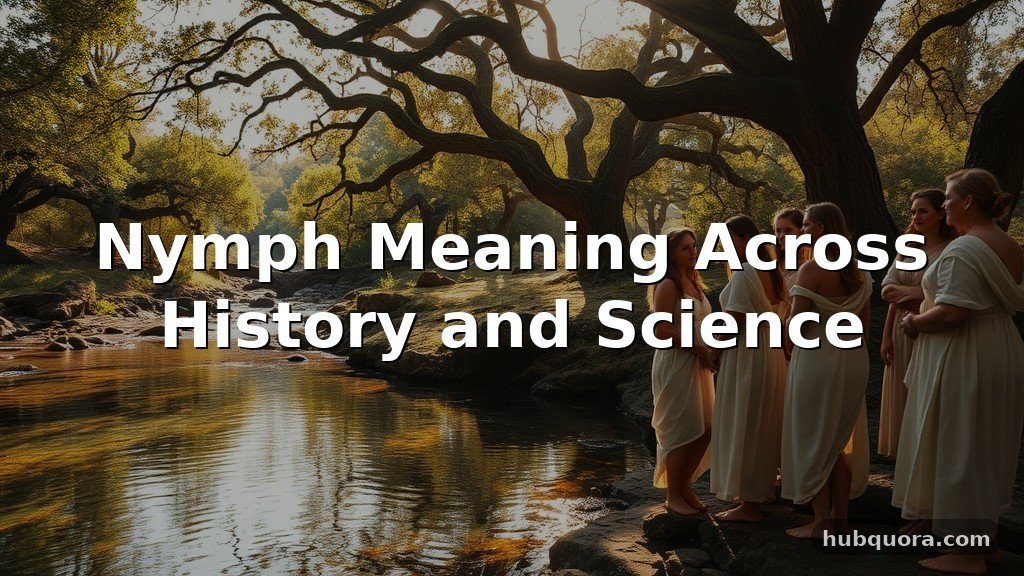
Exploring the diverse nymph meaning requires looking at both its ancient mythological roots and its precise biological definition. Whether you are curious about the ethereal figures of folklore or the developmental stages of insects, the term carries weight across very different disciplines.
By examining the word’s evolution from classical literature to modern science, you can better appreciate why it remains a common fixture in our language. This article breaks down these distinct interpretations to help you understand how context changes the definition entirely, providing clarity on everything from nature spirits to life cycles in the natural world.
The Classical Origins in Greek Mythology

In the context of Greek mythology, the nymph meaning is rooted in the concept of minor divinities associated with specific natural features. These figures were not considered immortal in the same way as the Olympian gods, but they possessed long lives and a deep, intrinsic connection to the world around them. They were typically envisioned as beautiful, youthful women who embodied the spirit of the wild landscapes they inhabited.
Ancient poets often described these beings as the personification of the creative power of nature. They were not merely passive inhabitants of the woods or streams; rather, they were seen as protectors of the environment.
If you look at an encyclopedia entry regarding these spirits, you will find they are categorized based on their habitat. For example, spring nymphs were specifically tied to the flow of fresh water, while others were bound to the life force of trees or the rugged terrain of mountains.
Categorizing Different Types of Nymphs
Because these entities were tied to the land, their classification is surprisingly systematic. Ancient writers like Hesiod and Homer utilized these categories to describe the geography of the known world. Understanding these categories is essential for grasping the nymph meaning in literature and art.
- Naiads: These were the spirits of fresh water, including fountains, wells, springs, and brooks.
- Dryads: These beings were the spirits of the forest, often specifically associated with oak trees.
- Oreads: These figures haunted the mountains and grottos, often accompanying the goddess Artemis during her hunts.
- Nereids: These were the sea spirits, often depicted as daughters of Nereus, the old man of the sea.
- Epimeliads: A specific class of spirits that watched over apple orchards and fruit-bearing trees.
This structural approach to defining them shows how the ancients used these stories to explain the natural phenomena they encountered daily. By assigning a spirit to a location, they created a narrative framework for the environment, making the wild world feel more intimate and predictable.
The Biological Definition of a Nymph
Transitioning from folklore to biology, the nymph meaning takes on a strictly scientific character. In entomology, the term refers to the young form of certain insects that undergo incomplete metamorphosis. Unlike a caterpillar that enters a pupal stage to transform into a butterfly, these insects go through a series of molts as they grow larger and develop adult features.
This process, known as hemimetabolous development, is common in groups like grasshoppers, cicadas, and dragonflies. During these stages, the insect often looks like a smaller, wingless version of the adult.
As they progress through these stages, they gradually develop reproductive organs and functional wings. It is a fascinating survival strategy that allows the creature to occupy different niches in the ecosystem throughout its life cycle.
Distinguishing Between Nymphs and Larvae
A common point of confusion is the difference between a nymph and a larva. While both terms describe immature stages, they represent fundamentally different life cycles.
A larva, such as a maggot or a grub, looks completely different from its adult form. The dictionary definition clarifies that a larva must undergo a complete metamorphosis—including a resting, pupal stage—before it can become an adult.
Nymphs, by contrast, are already active, feeding, and moving through their environment in a way that mirrors the adult’s behavior. They occupy the same habitat as the adults, which can lead to competition for food resources within the same species. Understanding this distinction is vital for researchers and gardeners alike, as it helps identify which pests are present and how they might impact plants or crops.
Linguistic Evolution and Cultural Usage
The word itself has traveled a long distance from its original Greek roots. In modern usage, the nymph meaning has expanded to include various colloquialisms, some of which are far removed from the original mythological associations. While the translation from the ancient Greek “nymphe” literally refers to a bride or a young woman, the term has been co-opted in various ways throughout history.
In literature, writers have often used the term to denote a sense of innocence or a connection to nature. However, it is important to be aware of how the term has evolved in slang.
In some social contexts, it has been used to objectify or stereotype, which can be derogatory. Being mindful of these nuances is part of understanding the full scope of the term’s impact on language and culture.
Addressing Topical Gaps in Folklore Studies
Many readers often ask if these figures were strictly female. The nymph meaning in Greek mythology is almost exclusively female, representing the feminine aspect of nature. Unlike the gods who had complex hierarchies, these spirits were often depicted as a collective, acting as a chorus or a background force to the main action of mythological tales.
Another gap often missed is the relationship between these spirits and human interactions. In ancient stories, these beings were not always benevolent.
They were known to be protective and could be dangerous to those who disturbed their sacred groves or springs. This duality—where the spirit of nature is both beautiful and potentially vengeful—is a critical component of the mythos that is often overlooked in simplified retellings.
The Role of Nymphs in Artistic Expression
Throughout the Renaissance and the Romantic era, artists frequently returned to the imagery of these spirits. Whether in painting, sculpture, or poetry, the nymph meaning served as a shorthand for the untamed beauty of the natural world. Artists used the figures to explore themes of desire, transformation, and the human relationship with the environment.
You can observe this trend in the works of masters like Botticelli or the poetry of Keats, where the presence of a forest spirit adds a layer of mystery and depth to the landscape. By placing a human-like figure within a natural setting, artists were able to anchor abstract concepts of beauty and wilderness into a form that the viewer could easily connect with on an emotional level.
Scientific Observation of Nymphal Stages
For those interested in the practical, hands-on study of biology, observing the life cycle of common garden insects provides a living laboratory. Many species of hemipteran insects, such as aphids or plant bugs, provide accessible examples of the nymphal stage. You can visit The Smithsonian Institution to learn more about the complexities of insect development and the specific environmental triggers that initiate their growth phases.
When tracking these stages, researchers look for specific markers like the shedding of the exoskeleton. Each time the insect molts, it enters a new instar. This systematic growth is a testament to the efficiency of evolution, allowing the organism to adapt to its surroundings without the need for a total biological reset.
Comparative Table of Definitions
To better visualize how the definition changes based on the field of study, the following table summarizes the key differences between the mythological and the biological interpretations of the term.
| Category | Mythological Context | Biological Context |
|---|---|---|
| Primary Domain | Folklore and Literature | Entomology and Zoology |
| Nature of Being | Supernatural Divinity | Immature Life Stage |
| Development | Eternal or Long-lived | Progressive Molting/Instars |
| Association | Nature and Landscape | Incomplete Metamorphosis |
Common Misconceptions and Clarifications
One of the most frequent misconceptions is that the term applies to any small creature or young animal. In reality, the scientific application is quite narrow and specific to certain insect orders.
Similarly, in mythology, not every female spirit is a nymph. For instance, dryads are distinct from the muses or the furies, each having different roles and origins within the Greek pantheon.
Correctly identifying the context is the first step in avoiding these common errors. When you encounter the word, take a moment to look at the surrounding text.
If the discussion involves biology, ecology, or gardening, you are likely looking at the developmental stage of an insect. If the discussion involves history, art, or ancient literature, you are dealing with the mythological spirit.
Frequently Asked Questions
What does it mean to be called a nymph?
Calling someone a nymph in a modern, non-mythological context can be a way to describe a woman who is perceived as having a youthful, energetic, or nature-loving quality. However, it is an archaic term that is rarely used in polite conversation today and can sometimes carry unintended, dated connotations.
Is a nymph always a female figure?
In the context of Greek mythology, yes, they are almost exclusively depicted as female figures. They represent the feminine, creative energy of the natural world. There is no direct male equivalent in the same sense, although other nature spirits, like satyrs or fauns, occupy similar roles in the mythology.
What is the nymph personality?
The “nymph personality” is not a scientific term but rather a literary archetype. It describes someone who is often seen as free-spirited, ethereal, and deeply connected to nature. People described this way are often viewed as elusive, charming, and perhaps a bit detached from the rigid structures of society.
Are nymphs found in all insect species?
No, they are only found in insects that undergo incomplete metamorphosis, known as hemimetabolous insects. Insects that undergo complete metamorphosis, such as butterflies, beetles, and bees, do not have a nymphal stage; instead, they progress through egg, larva, pupa, and adult stages.
Conclusion
The nymph meaning serves as a bridge between the ancient world of imagination and the empirical world of science. Whether you are delving into the rich tapestry of Greek nymphs who inhabited the ancient landscape or observing the life cycle of an insect in your backyard, the term helps us categorize our understanding of the world. It reminds us that humanity has always sought to name and organize the forces of nature, from the spirits in the trees to the tiny creatures crawling beneath the leaves.
By recognizing the nuances between these two primary definitions, you gain a deeper appreciation for how language shifts to suit our needs. We invite you to continue exploring these topics, as looking at the world through both a mythological and a scientific lens offers a much more complete picture of our natural environment.

James Wilson is the founder and lead editor of HubQuora.com, where he covers the latest celebrity news, entertainment trends, viral gossip, and net worth stories. With a passion for pop culture and digital media, James delivers engaging, accurate, and up-to-date content that keeps readers informed about the world of celebrities, influencers, and entertainment industry buzz.