
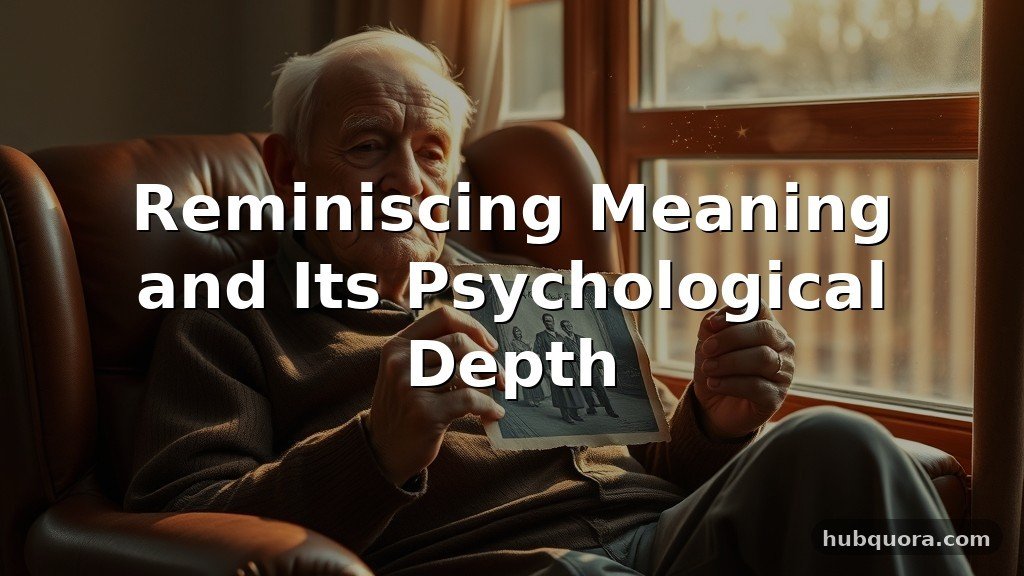
Understanding the true reminiscing meaning goes far beyond simply looking back at old photographs or sharing stories from your youth. It is a sophisticated cognitive process that allows us to bridge the gap between our current identity and the experiences that shaped it.
When you engage in this act, you are not just passively viewing a movie of your life; you are actively re-engaging with emotions, sensory details, and lessons that remain tucked away in your consciousness. Grasping what it means to look back with intention can transform how you handle the present, turning fleeting thoughts into a grounded sense of self.
The Core Definition and Linguistic Roots

At its most basic level, the term refers to the act of indulging in enjoyable recollections of past events. The word itself functions as a verb, describing an active engagement with your personal history.
If you check a standard dictionary entry for the term, you will find it defined as the act of talking or thinking about things that happened in the past. It is a social and internal activity that requires a conscious effort to pull a memory from the depths of your mind into the light of the present.
The linguistic evolution of the word suggests a deep connection to the idea of “remembering” in a way that is tinted by sentimentality. Unlike a dry report of facts, to reminisce is to color those facts with the emotions you felt at the time.
When you are reminiscing, you aren’t just reciting a list of dates or locations; you are recreating a feeling. This nuance is why the term carries a warm, often nostalgic connotation that distinguishes it from the clinical act of simple information retrieval.
Psychological Benefits of Looking Back
Engaging in this reflective practice provides significant mental health benefits. Psychologists often point to the idea that reminiscing can bolster our self-esteem and provide a sense of continuity.
When life feels chaotic or overwhelming, looking back at times when you navigated similar challenges can remind you of your own resilience. It confirms that you are the same person who overcame those hurdles, which helps stabilize your identity during turbulent periods.
Furthermore, these reflections act as a buffer against loneliness. Sharing stories about your school days or early career with a friend creates a bond that transcends the present moment.
By inviting someone else into your history, you are essentially saying, “This is part of who I am.” This exchange of personal narratives is a fundamental component of building lasting relationships, as it allows others to see the trajectory of your life and understand the values you have carried forward.
Distinguishing Between Reminiscing and Ruminating
It is vital to understand the difference between healthy reflection and the cycle of rumination. While the reminiscing meaning centers on the enjoyment or appreciation of the past, rumination is often characterized by repetitive, negative loops of thought.
Rumination keeps you stuck in past mistakes or regrets, often leading to anxiety or depression. In contrast, healthy reflection serves to integrate the past into a broader, more accepting view of your current life.
Identifying Healthy Reflection
- You feel a sense of warmth or curiosity rather than shame or guilt.
- The focus is on the narrative arc of your life rather than a single embarrassing moment.
- You can identify specific lessons learned that inform your current decision-making.
- The process leaves you feeling connected to your past self rather than alienated from it.
If you find that your thoughts about the past are consistently causing distress, it may be time to shift your perspective. Instead of focusing on “what went wrong,” try to focus on “what I gained.” This small shift in focus can turn a potentially harmful habit into a constructive tool for personal growth.
The Role of Sensory Triggers in Memory
Why do certain smells, songs, or tastes pull us back to a specific time so vividly? This phenomenon, often called the Proustian effect, highlights how sensory input bypasses our analytical mind and hits the emotional centers directly. When you walk into a room and the scent of a particular floor wax reminds you of your elementary school hallways, you aren’t just thinking about that memory; you are experiencing a visceral reaction to it.
These sensory triggers are the keys that unlock the doors to our subconscious. Because these memories are tied to physical sensations, they are often more resilient than abstract facts.
Recognizing this helps us understand that when we are reminiscing, we are often responding to environmental cues that we might not even be consciously aware of. By being more mindful of these triggers, you can better manage your emotional state and choose which parts of your history you want to lean into.
Common Idioms and Expressions
Language is filled with phrases that capture the act of looking back. We often use idioms to describe this process, such as “taking a trip down memory lane” or “seeing things through rose-colored glasses.”
These expressions highlight the subjective nature of our history. When we talk about “the good old days,” we are acknowledging that our view of the past is filtered through our current perspective.
Table: Common Phrases Related to Reflection
| Phrase | Implied Meaning | Tone |
|---|---|---|
| Trip down memory lane | Actively revisiting past experiences | Nostalgic |
| Rose-colored glasses | Idealizing past events | Critical/Objective |
| Blast from the past | A sudden, unexpected memory | Surprising |
| Living in the past | An unhealthy obsession with history | Cautionary |
Each of these phrases serves a specific purpose in conversation. They allow us to categorize our thoughts about the past without needing to explain the entire cognitive process. Using these words helps simplify the complex nature of our inner lives, making it easier to communicate our state of mind to others.
Addressing Topical Gaps: Why Do We Forget?
A common question that arises when discussing the reminiscing meaning is why some memories seem to fade while others remain crystal clear. It is important to realize that the brain does not record life like a video camera.
Instead, it reconstructs events based on the information it deems most relevant at the time. If a memory isn’t revisited, the neural pathways associated with it become less efficient, making the event harder to recall.
Conversely, the events we share with others or write about in a log or journal tend to remain more vivid. The act of verbalizing or documenting an event forces the brain to organize the information, strengthening the connections between the sensory details and the narrative. If you want to preserve a particular time in your life, you don’t necessarily need to obsess over it; you just need to revisit it occasionally in your mind or through conversation.
The Social Dimension of Shared History
When you are reminiscing with a group, the experience changes. It becomes a collaborative effort to reconstruct the past.
One person might mention a detail—a specific song that was playing or the weather on that particular afternoon—and it acts as a catalyst for others to unlock their own buried memories. This collective storytelling is a powerful social glue.
It also serves as a check and balance for our personal narratives. Sometimes, we might misremember a detail, and having someone else there to correct or fill in the blanks provides a more accurate picture of what actually occurred.
This social aspect reminds us that our history is not just ours alone; it is shared with the people who were there with us. It reinforces our place within a community and validates our shared experiences.
Cultural Variations in Reflective Practice
While the impulse to look back is universal, the way different cultures handle this process varies wildly. In some societies, elders are viewed as the primary repositories of history, and their act of reminiscing is a revered duty.
They are tasked with passing down traditions, lessons, and family lineage to the next generation. In these contexts, the focus isn’t just on personal enjoyment; it’s on cultural preservation.
In more fast-paced, individualistic cultures, there is often a stronger emphasis on “moving forward” and “letting go” of the past. This can create a conflict where the natural human urge to look back is viewed as a sign of being stuck or unproductive. However, balancing the two is essential.
You can honor your past while still being fully committed to your future. The key is to ensure that your reflections serve your current goals rather than hindering them.
The Impact of Digital Documentation
In the modern era, we have an unprecedented amount of external storage for our lives. We have digital logs, social media feeds, and thousands of photos on our phones.
This has changed the reminiscing meaning significantly. We no longer have to rely solely on our fallible brains to reconstruct the past; we can simply scroll back through a digital timeline.
While this is convenient, it can also lead to a more passive form of reflection. Instead of the active, cognitive work of pulling a memory from the mind, we are often just consuming content about our past.
To get the psychological benefits of true reflection, it is important to go beyond the digital surface. When you see an old photo, take a moment to sit with the emotions that arise, rather than just liking the post and moving on.
Practical Tips for Intentional Reflection
If you want to make your practice of looking back more meaningful, consider setting aside specific time for it. This doesn’t have to be a heavy, formal event.
It could be as simple as setting aside a few minutes each week to write down one thing you appreciate about a past experience. By doing this, you are training your brain to seek out positive narratives.
Another effective method is to engage in “thematic reflection.” Instead of just thinking about the past in a chronological way, pick a theme—such as “times I felt courageous” or “people who influenced my career”—and see how those themes have evolved. This helps you identify patterns in your behavior and character that might not be obvious when you are just looking at a linear timeline of events.
FAQ Section
What does it mean to be reminiscing?
To be reminiscing means to actively engage with your past, intentionally bringing memories to the forefront of your mind to reflect on them. It involves feeling the emotions associated with those events and often includes sharing these stories with others to build connection and personal insight.
Is reminiscing considered a positive or negative habit?
It is generally considered a positive habit. When done with intention, it can boost self-esteem, strengthen social bonds, and provide a sense of continuity. However, it can turn negative if it crosses into rumination, where you become trapped in repetitive, distressing thoughts about past failures or regrets.
What is the difference between reminiscing and just remembering?
Remembering is a broad term for the cognitive ability to retrieve information. Reminiscing is a specific, often sentimental, form of remembering. It involves a deeper emotional engagement with the past, usually with the goal of enjoying the memory or deriving meaning from it, rather than just recalling a fact.
How can I tell if I am reminiscing too much?
You might be overdoing it if your focus on the past starts to interfere with your ability to enjoy or function in the present. If you find yourself constantly wishing to return to a previous time or feeling unable to make decisions without comparing them to the past, it’s time to refocus.
Conclusion
Grasping the true reminiscing meaning allows you to reclaim your history as a tool for growth rather than a source of distraction. By engaging with your past intentionally, you create a stronger sense of self and deepen your connections with those around you. Remember that your memories are not static; they are living, breathing parts of your identity that change as you do.
Whether you are looking back at a specific time or simply reflecting on the long road you have traveled, treat your history with kindness and curiosity. Take the time to acknowledge where you have been, and use that wisdom to inform where you are going next. If you have found this exploration helpful, consider sharing a meaningful memory with someone today to start a conversation.

James Wilson is the founder and lead editor of HubQuora.com, where he covers the latest celebrity news, entertainment trends, viral gossip, and net worth stories. With a passion for pop culture and digital media, James delivers engaging, accurate, and up-to-date content that keeps readers informed about the world of celebrities, influencers, and entertainment industry buzz.