
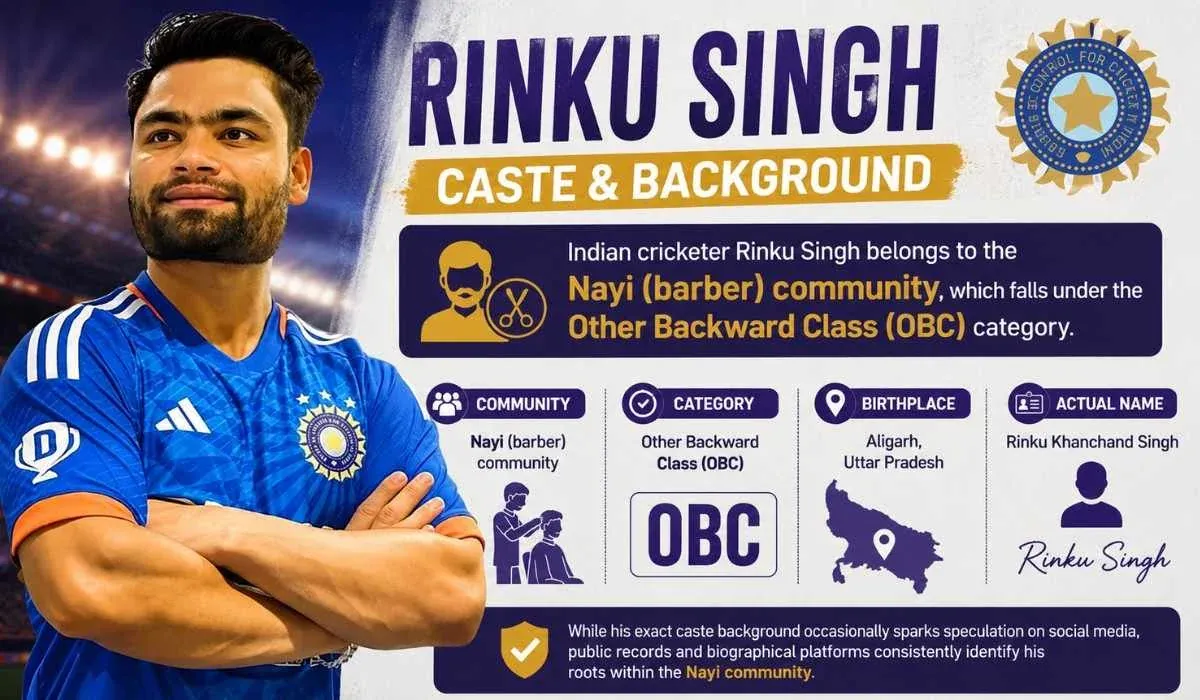
Questions about Rinku Singh’s caste appear frequently alongside searches for his age, father, highest score, wife, and net worth. However, caste is sensitive personal information, and there is no clearly verified public statement from the cricketer or an official biographical record that definitively establishes his caste identity. What can be discussed responsibly is his publicly reported family background, hometown, sporting journey, and the difference between documented facts and online speculation.
Rinku Singh is an Indian cricketer from Aligarh, Uttar Pradesh, who became widely known for his left-handed batting and memorable performances in domestic cricket and the Indian Premier League. His rise from a financially modest family to international cricket has made his personal story highly searched. That interest, however, should not be treated as permission to present unverified caste claims as fact.
What is publicly known about Rinku Singh’s caste?
No authoritative public source clearly confirms Rinku Singh’s caste. Online pages sometimes attach a caste label to him, but those claims are not supported by a verifiable statement from Rinku Singh, his family, an official cricket body, or a reliable biographical record.
The most accurate answer is therefore a cautious one: Rinku Singh’s caste has not been conclusively established in dependable public documentation. Some internet discussions associate him with a particular community, including claims that he belongs to the Jatav community, but repetition across websites does not turn an allegation into verified fact. A responsible article should distinguish between “reported online” and “confirmed by evidence.”
This distinction matters because caste identity can be personal, regional, and politically sensitive. A surname, hometown, occupation, language, or economic background cannot reliably prove caste.
Even a community label used by one family member may not be enough to establish how an individual identifies publicly. In India, caste records may also use administrative categories that differ from everyday social descriptions.
Several common assumptions should therefore be avoided:
- A surname does not prove caste. The same surname may occur across different communities and regions.
- Poverty does not identify caste. Financial hardship affects families from many social groups.
- Aligarh does not determine community identity. A city contains multiple religious, linguistic, and caste communities.
- Search-result repetition is not verification. Many websites copy the same unsupported claim.
- A player’s selection category is not a caste certificate. Sporting contracts and team records do not normally disclose caste.
For readers searching specifically for “Rinku Singh caste,” the most defensible conclusion is that the answer remains unconfirmed in reliable public sources. His cricket career is well documented; his caste is not.
Rinku Singh’s family background and Aligarh roots
Rinku Singh comes from Aligarh, Uttar Pradesh, and his family background is central to his public story. His father is widely identified in media coverage as Khanchandra Singh, with some sources using the spelling Khanchand Singh.
Rinku Singh was born on 12 October 1997 in Aligarh, a city known for its lock industry, educational institutions, and long sporting tradition. Reports about his early life describe a household with limited financial resources.
His father worked as a delivery worker associated with gas-cylinder distribution, and the family reportedly lived in modest circumstances. These details help explain the significance of Rinku’s rise, but they do not establish his caste.
His father’s name appears in more than one spelling because English-language reporting often transliterates Hindi names differently. “Khanchandra Singh” and “Khanchand Singh” may refer to the same person, rather than two separate individuals. Readers should be careful when treating spelling variations as evidence of different family identities.
Rinku’s family story is often framed around sacrifice and persistence. Cricket equipment, travel, coaching, and tournament fees can create serious pressure for families with limited income.
Young players from smaller cities may also need to balance training with family responsibilities. In Rinku’s case, the public narrative focuses on how he continued pursuing cricket despite those obstacles.
It is useful to separate three different kinds of information:
| Information type | What is reasonably documented | What it does not prove |
|---|---|---|
| Birthplace | Aligarh, Uttar Pradesh | A particular caste identity |
| Father’s name | Khanchandra Singh or Khanchand Singh in different reports | Community classification |
| Family finances | Reports describe a modest economic background | Caste, reservation status, or official category |
| Cricket career | Domestic, IPL, and international appearances | Personal social identity |
These distinctions prevent a compelling sports biography from becoming an unsupported caste narrative. Rinku’s origins are meaningful because they illuminate his journey, not because they provide a shortcut to identifying a private social category.
How Rinku Singh became a prominent Indian cricketer
Rinku Singh became prominent through domestic cricket, the IPL, and powerful finishing performances. His batting reputation grew because he combined clean striking with composure in difficult run chases.
Rinku first attracted serious attention through Uttar Pradesh cricket. Like many Indian players, he developed through age-group competitions, domestic tournaments, and franchise scouting.
His left-handed batting offered teams a useful variation, particularly in the middle and lower-middle order. He became known as a finisher: a batter expected to score quickly near the end of an innings and handle pressure when the required run rate is high.
His association with Kolkata Knight Riders helped bring him to a national audience. The defining moment of his early IPL fame came when he struck five consecutive sixes in the final over against Gujarat Titans in 2023.
That performance was not simply a display of power. It demonstrated match awareness, confidence under extreme pressure, and the ability to select scoring options against a changing bowling attack.
Rinku’s highest-profile innings also changed the way the public discussed him. Before that achievement, he was primarily known to domestic followers and franchise-cricket viewers.
After it, he became a mainstream sporting figure whose personal life, family, age, and caste attracted intense search interest. This pattern is common: a single remarkable performance can rapidly expand public curiosity beyond the athlete’s professional record.
His international opportunity followed his strong T20 performances. Rinku Singh represents India in limited-overs cricket, especially the Twenty20 format, where finishing ability and boundary-hitting are highly valued.
International selection reflects performance, tactical fit, fitness, and team requirements. It does not reveal a player’s caste or social classification.
His cricketing profile can be summarised through several strengths:
- Left-handed batting: His batting angle creates a different challenge for bowlers and gives teams greater lineup balance.
- Finishing skill: He is particularly associated with scoring rapidly during the closing overs.
- Pressure handling: His best-known innings came in a situation requiring extraordinary composure.
- Domestic grounding: Uttar Pradesh cricket provided an important development platform.
- Franchise exposure: IPL cricket placed him in high-pressure matches watched by a global audience.
These are verifiable sporting attributes and offer a more useful understanding of Rinku Singh than unsupported claims about caste.
Why online caste claims about cricketers spread so quickly
Online caste claims spread because search demand, copied biographies, and assumptions about identity often reinforce one another. A claim may appear on dozens of pages without having a reliable original source.
When a player becomes famous, users commonly search for personal details that are not part of official scorecards. Queries about parents, marital status, religion, caste, net worth, age, and education often grow at the same time.
Content publishers notice those searches and produce short biographies. Some writers then copy information from existing pages, creating a circular system in which repetition looks like confirmation.
There are several reasons this happens in the case of Indian sports figures:
Search engines reward specific questions
Queries such as “Rinku Singh father age” or “Rinku Singh highest score” are highly specific. Publishers may try to answer them quickly, even when dependable information is limited. Caste queries are particularly vulnerable because readers may expect a single, definitive label despite the absence of a primary source.
Community assumptions are often treated as facts
Writers sometimes infer caste from a surname, region, religion, or social-media comment. This is weak reasoning.
Indian surnames can be shared by several communities, and local identities do not always map neatly onto broad national categories. An assumption may sound plausible while still being wrong.
Administrative categories create further confusion
Terms such as Scheduled Caste, Other Backward Class, Scheduled Tribe, and General Category are administrative classifications used in particular legal and institutional contexts. They are not interchangeable with every community name used in ordinary conversation. A web article that confuses these terms can mislead readers even if the author intended to be informative.
Personal information becomes part of celebrity culture
Athletes are public figures professionally, but that does not mean every private attribute should be guessed. The public has a legitimate interest in a player’s statistics, selection history, and achievements. Caste identity is different unless the individual has chosen to discuss it openly and clearly.
The best way to assess a claim is to ask whether it comes from a direct interview, an official biography, a legal or institutional document, or merely another unsourced website. That simple check eliminates much of the noise.
Rinku Singh’s caste, privacy, and responsible reporting
Responsible reporting should acknowledge uncertainty instead of assigning a caste label without consent or evidence. Accuracy and privacy are especially important when discussing sensitive personal attributes.
A useful standard is to publish only what can be attributed. For example, a writer can say that Rinku Singh is from Aligarh, that reports identify his father as Khanchandra Singh, and that his family faced financial difficulties. A writer should not convert those facts into a definite caste claim unless a credible source directly supports it.
This approach benefits readers in several ways. First, it prevents misinformation from becoming embedded in search results.
Second, it respects the individual’s right to define his own identity. Third, it avoids reducing a successful sportsperson to a caste label rather than recognising his work and ability.
Readers who want dependable career information can consult the official Board of Control for Cricket in India website for Indian cricket-related announcements and player information. Official sports records are generally more reliable for matches, squads, and career milestones than anonymous biography pages.
When evaluating a public claim, use this practical checklist:
- Identify the original source rather than relying on copied articles.
- Check whether the person has made a direct public statement.
- Separate a reported claim from a verified fact in the wording.
- Look for consistent information from reputable institutions or established publications.
- Avoid inferring caste from a surname, location, income, appearance, or occupation.
- Consider whether publishing the detail serves a legitimate informational purpose.
This is not about avoiding difficult subjects. It is about describing them precisely.
A sentence such as “some online sources claim…” is more honest than presenting an uncertain label as settled truth. In a fast-moving digital environment, that small difference matters.
How caste categories differ from identity and cricket selection
Caste identity, government classification, and cricket selection are separate concepts. A player’s selection for India or an IPL franchise does not disclose whether he belongs to a particular caste category.
Caste in India operates through a mixture of historical community structures, local social practices, family identity, and government policy. The same community may be described differently across states or administrative contexts.
Official certificates, where relevant, are issued through specific procedures and authorities. A media biography cannot substitute for such documentation.
Cricket selection follows a different logic. Selectors consider performance, role, fitness, temperament, tactical needs, and competition for places.
A batter may be selected because he can clear the boundary, rotate strike, face spin effectively, or finish a chase. None of those criteria identifies caste.
This distinction is important when readers search for a player’s “category.” In sports reporting, “category” might refer to a batting position, player type, auction bracket, age group, or tournament registration. In public policy, it may refer to a reservation classification. These meanings should not be blended casually.
Rinku Singh’s own sporting identity is better described through observable facts: he is an Indian left-handed batter, he developed through Uttar Pradesh cricket, he played in the IPL, and he earned international opportunities. Those facts explain his career without making assumptions about personal identity.
There is also a broader social point. Many young athletes from underrepresented or economically weaker backgrounds become symbols of aspiration.
Their stories can encourage investment in grassroots sport, better coaching access, and improved facilities. That social value is lost when coverage focuses narrowly on an unverified caste label instead of examining the structural barriers the player overcame.
In short, caste may be relevant to a person’s own public discussion of identity, but it should never be reverse-engineered from a scorecard or a biography.
Related facts: age, father, highest score, wife, and net worth
Most searches connected with Rinku Singh’s caste concern his cricket career and family, but several details require careful wording because they can change or remain incompletely documented.
Rinku Singh was born in October 1997, making his age dependent on the date when the calculation is made. Articles that state a fixed age without mentioning a reference date can quickly become outdated.
His father is generally named as Khanchandra Singh, although Khanchand Singh is also used in some reports. This appears to be a transliteration difference.
His highest score depends on the format being discussed. A batter can have one highest score in first-class cricket, another in List A matches, another in the IPL, and another in international cricket. Readers should therefore specify the competition before treating a “highest score” figure as complete.
Questions about a wife or relationship status should also be handled carefully. Public interest does not justify inventing a spouse, engagement, or romantic relationship. Unless Rinku Singh has publicly confirmed such information, it is safer to say that a verified marital detail is not available.
The same caution applies to net worth. Estimates published online often combine assumed IPL salary, endorsements, prize money, property, and personal assets.
These figures are rarely audited or officially disclosed. A reported contract value is not the same as total wealth, and gross earnings are not the same as take-home income.
The following summary separates stronger public information from areas where readers should remain cautious:
| Search topic | Responsible summary |
|---|---|
| Age | Born in October 1997; exact age changes with the date. |
| Father | Often identified as Khanchandra Singh or Khanchand Singh. |
| Highest score | Must be specified by format or tournament. |
| Wife | No widely verified public marital detail should be assumed. |
| Net worth | Online estimates are speculative unless supported by financial disclosure. |
| International career | He has represented India in limited-overs cricket. |
This framework gives readers useful answers while avoiding false precision. It also demonstrates why a single biography page should not be treated as an authoritative source for every personal detail.
Topical gaps: what existing discussions often fail to explain
The biggest gap in discussions of Rinku Singh’s caste is the failure to explain what is verified, what is inferred, and why the distinction matters. A useful article should answer those questions directly rather than simply repeat a community label.
Is there an official caste statement?
There is no broadly recognised official statement from Rinku Singh that conclusively identifies his caste in dependable public records. Without a direct statement or authoritative documentation, a definitive answer would be speculative.
Does his father’s name reveal caste?
No. Khanchandra Singh is a personal name, and names alone cannot establish caste. Even when a surname is strongly associated with a community in one area, it may be used by other groups elsewhere.
Does Aligarh reveal his caste?
No. Aligarh is a diverse urban and regional setting. Knowing that a person was born or raised there provides geographical context, not proof of community identity.
Does an IPL or international contract reveal caste?
No. Professional cricket contracts document employment, compensation, performance obligations, and team participation. They do not ordinarily publish caste identity.
Why do some pages give a definite answer?
Some pages may rely on copied material, informal community claims, or unsupported assumptions. A confident tone can make a weak claim appear factual, which is why readers should look for a named source and primary evidence.
These gaps are not minor technicalities. They affect how public figures are represented.
If an unverified caste claim is repeated long enough, it can become difficult for readers to distinguish documentation from internet folklore. Clear language—“not publicly confirmed,” “reported by some sources,” or “no reliable record found”—is the more accurate approach.
Why Rinku Singh’s cricket achievements matter more than speculation
Rinku Singh’s sporting achievements provide a well-supported account of his public identity. His career shows how domestic cricket and franchise tournaments can create a route to international recognition.
His rise is notable because it was not built on a single pathway. He developed in the Uttar Pradesh cricket system, gained visibility through professional competition, and used IPL opportunities to demonstrate his value in high-pressure situations. That progression illustrates the importance of performance over time rather than one lucky innings.
The five-sixes finish became a defining cultural moment because it was easy for audiences to understand: a difficult chase, a final over, and an unlikely victory. Yet the moment represented more than entertainment. It showed how a player who had worked outside the spotlight could become one of the most recognisable young batters in India.
His story also raises useful questions about access to sport. Equipment costs, travel, coaching, nutrition, and time away from work can all influence whether a talented young player remains in the game.
When a cricketer from a modest background succeeds, the lesson is not that hardship is necessary for excellence. The better lesson is that systems should make talent easier to identify and support.
For fans, the most meaningful way to follow Rinku Singh is to examine his runs, strike rate, match situations, selection history, fitness, and development as a batter. Those measurable elements offer a richer picture than a disputed personal label. They also remain relevant to the player’s professional contribution, whether he is appearing in domestic, IPL, or international cricket.
His continuing career may add new milestones, and future official interviews may clarify personal matters if he chooses to discuss them. Until then, the sensible position is to celebrate documented achievements while treating caste claims with restraint.
Conclusion
Available public information does not conclusively verify Rinku Singh’s caste, and online claims should not be presented as established fact. What is well documented is his Aligarh background, his family’s modest circumstances, his father’s reported name, and his rise from Uttar Pradesh cricket to the IPL and international cricket.
Readers looking into Rinku Singh’s caste should check primary sources, separate evidence from repetition, and respect personal privacy. His batting achievements and journey already provide a compelling story without relying on speculation.
Frequently asked questions
What is Rinku Singh’s caste?
Rinku Singh’s caste is not conclusively confirmed in reliable public records. Some online sources attach a community label to him, but those claims lack clear primary verification. A surname, birthplace, family income, or cricket career cannot establish caste, so it is more accurate to describe the information as unverified.
Who is Rinku Singh’s father?
Rinku Singh’s father is commonly identified in media reports as Khanchandra Singh, although the spelling Khanchand Singh also appears. These variations likely reflect transliteration from Hindi into English. Reports describe him as working in gas-cylinder delivery, but that occupational detail does not establish the family’s caste.
Where was Rinku Singh born?
Rinku Singh was born in Aligarh, Uttar Pradesh, in October 1997. Aligarh forms an important part of his public biography because he developed his early cricketing identity there. His birthplace provides geographical context, however, and should not be used to infer his caste or community background.
Why is Rinku Singh famous?
Rinku Singh is famous for his left-handed batting, IPL performances, and ability to finish difficult run chases. His most celebrated moment came when he hit five consecutive sixes in a final over in 2023. He later earned opportunities to represent India in limited-overs international cricket.

James Wilson is the founder and lead editor of HubQuora.com, where he covers the latest celebrity news, entertainment trends, viral gossip, and net worth stories. With a passion for pop culture and digital media, James delivers engaging, accurate, and up-to-date content that keeps readers informed about the world of celebrities, influencers, and entertainment industry buzz.