
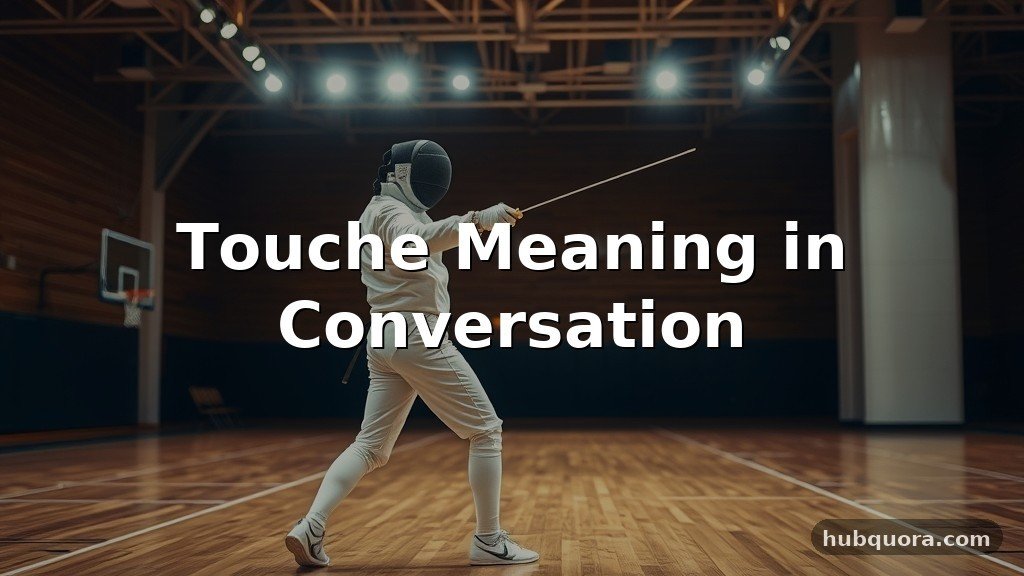
Understanding the true touche meaning requires looking beyond its literal roots to how it functions in modern English conversation. While many people use it reflexively during a debate, it serves a very specific purpose as an acknowledgment of a clever or valid point made by an opponent. Grasping this nuance helps you navigate social arguments and lighthearted banter with greater precision.
By exploring its origins in the sport of fencing and its evolution into common parlance, you will gain a clearer perspective on when to deploy this expression effectively. This article breaks down the history, usage, and social implications of this versatile term to ensure you use it correctly in any setting.
The Linguistic Origins of the Term

The word originates directly from the French language, specifically as the past participle of the verb toucher, which translates to “to touch.” In its native context, it refers to the physical act of making contact. However, its transition into English occurred through the specialized domain of competitive fencing.
In this sport, when one fencer successfully strikes their opponent with the tip of their foil, epee, or saber, the referee announces “touché.” This signals that a point has been scored because the fencer has made contact with the target area.
Because the sport relies on precision, speed, and strategy, the term became synonymous with a successful maneuver. Over time, the concept migrated from the fencing strip into everyday verbal exchanges. Just as a fencer acknowledges a successful hit, a conversationalist uses the word to acknowledge a “hit” in an argument.
When someone makes a particularly sharp, witty, or undeniable point that leaves you momentarily speechless, you are effectively admitting that they have “touched” your logic or argument. It is a graceful way to concede a small victory in a debate.
Decoding the Social Function of Touché
When you hear someone say “touché,” they are rarely talking about physical contact. Instead, they are participating in a social ritual of mutual respect. By using the word, a person signals that they recognize the intelligence or wit behind the other person’s retort.
It acts as a verbal white flag, signaling that the point was well-taken and perhaps even difficult to counter. This makes it a powerful tool for de-escalating tension during heated discussions or friendly disagreements.
Using the term requires a certain level of self-awareness and humility. It implies that you are secure enough in your stance to admit when you have been outmaneuvered by a clever remark.
If someone presents a counter-argument that is logically sound or humorous enough to dismantle your previous point, offering a quick “touché” shows that you value the quality of the interaction over the need to “win” at all costs. It shifts the dynamic from a confrontational battle to a collaborative exchange of ideas.
Common Misconceptions and Grammar Usage
One of the most frequent mistakes people make is treating the word as a generic exclamation for any type of agreement. However, the touche meaning is strictly tied to the concept of being “hit” by an argument. If you simply agree with someone, saying “I agree” or “fair point” is more appropriate.
Using this specific term when you haven’t actually been countered can make the speaker seem confused or pretentious. It is a term of concession, not just an affirmation of a fact.
From a grammar perspective, it is important to note that the term is a loanword. Because it is borrowed from French, it technically retains the acute accent on the final ‘e’. While many people omit this in casual text messages or emails for the sake of speed, professional writing or formal correspondence should include it to maintain accuracy.
Furthermore, it is almost always used as a standalone interjection. You do not need to follow it with a long explanation; the beauty of the word lies in its brevity and its ability to stand alone as a complete thought.
Defining the Term in Modern Contexts
In the digital age, the way we use words has shifted rapidly. You will often see the term appearing in comment sections on social media or in group chats.
In these environments, it is frequently used to validate a “burn” or a particularly funny comeback. If a user on a platform like Merriam-Webster might define it as an acknowledgment of a hit, the internet has expanded this to include “roasts” or clever memes that shut down an argument.
Clarifying the Topical Gaps
Many users often ask if the term is inherently positive. The answer is that it is neutral-to-positive. It is not necessarily a compliment to the person’s character, but it is a compliment to their wit.
Another common gap involves whether it means “back at you.” While it acknowledges a point, it is not a synonym for “returning” an insult. It is a passive acknowledgment of defeat in that specific moment.
Finally, people often wonder if it is used in English as a way to end a conversation. It can certainly serve as a conversation stopper if the point made was definitive enough that no further rebuttal is possible.
Comparative Usage of Concessionary Terms
To better understand where the word fits in your vocabulary, it helps to compare it to other ways of conceding a point. Different expressions carry different weights and social implications.
| Expression | Context | Intensity |
|---|---|---|
| Touché | Witty or logical defeat | High (Playful) |
| Fair point | General agreement | Low (Neutral) |
| You win | Total concession | High (Definitive) |
| I stand corrected | Factual error | Medium (Formal) |
As shown in the table, the term stands out because it specifically addresses the sharpness of a comment. If someone points out a factual error in your statement, “I stand corrected” is the standard response.
If someone makes a joke that perfectly highlights your hypocrisy, “touché” is the perfect response. Choosing the right term ensures that your tone matches the situation, preventing you from sounding overly formal when you should be casual, or vice versa.
The Role of Tone and Delivery
The effectiveness of this expression is heavily dependent on your delivery. Because it is a borrowed term, it can sound sarcastic if spoken with a sneer or a dismissive shrug. If you are genuinely impressed by someone’s logic, a sincere tone goes a long way.
When used in a friendly, lighthearted way, it can actually strengthen the bond between two people. It shows that you can laugh at yourself and appreciate the mental agility of your conversation partner.
However, be cautious about overusing it. If you say it after every single point someone makes, it loses its impact and can start to sound like a nervous tic or an insincere habit.
The best way to use it is sparingly, saving it for those rare moments when someone truly catches you off guard with a brilliant insight. By treating it as a special tool, you ensure that when you do use it, the other person feels recognized and validated.
Historical Evolution from Italian and French Roots
While the term is undeniably French, the history of the sport of fencing itself is deeply intertwined with Italian traditions. During the Renaissance, masters of the blade in Italy developed the systems that would later be refined by the French schools.
The terminology used in modern fencing is a blend of these two cultures. The word “toucher” is the French contribution, but the concept of the “touch” as a scoring unit has roots in the broader European history of dueling and swordsmanship.
Understanding this lineage adds a layer of depth to your usage. You are participating in a tradition that spans centuries, moving from the dueling grounds of Europe to the modern boardroom or living room.
It is a reminder that language is a living, breathing log of our cultural history. Even as we use it to talk about a funny comment on the internet, we are still invoking the spirit of the duel, acknowledging the skill of the person who bested us in the intellectual arena.
Common Scenarios for Usage
You might wonder when exactly you should reach for this word. It is most effective in scenarios involving a debate, a joke, or a friendly wager. Consider these common situations:
- During a debate when your opponent points out a flaw in your evidence that you hadn’t considered.
- When a friend makes a clever pun that perfectly summarizes your situation, even if it’s at your expense.
- In a professional setting where a colleague provides a counter-proposal that is objectively better than your original idea.
- When you are playing a game of wits and your opponent successfully traps you in a logical inconsistency.
In each of these cases, the word acts as a bridge. It allows you to move past the moment of defeat without holding a grudge. It acknowledges that the other person brought something valuable to the table, and it allows the conversation to continue on a more productive footing.
The Psychology of Concession
Why do we feel the need to acknowledge when we’ve been “hit” in conversation? Psychologically, it serves as a mechanism for social cohesion. When two people argue, there is an inherent risk of hostility.
By admitting that the other person made a good point, you effectively lower the defenses. It is a way of saying, “I am listening to you, and I value your contribution.” This is essential for healthy communication.
In many ways, the term represents a form of intellectual honesty. It takes a certain amount of confidence to admit that your argument was not airtight. People who use this term regularly are often viewed as more approachable and less defensive.
They prioritize the pursuit of truth or the enjoyment of a good conversation over the ego-driven need to be right at all times. This makes it a valuable asset for anyone looking to improve their social intelligence.
Integrating the Term into Your Vocabulary
If you want to use the word more effectively, start by paying attention to the quality of the points being made in your daily interactions. Don’t just throw it into sentences to sound sophisticated. Instead, wait for those moments where you genuinely feel a sense of “Aha!” or “That was a good one.”
That is the natural environment for the word. When you use it correctly, it will feel seamless and effortless.
Remember that you don’t need a specific list of rules to govern your speech, but keeping the context in mind is helpful. If you are in a very serious, high-stakes meeting, you might opt for “That is a fair point” to maintain a professional tone.
In a casual setting, “touché” is perfectly acceptable and often preferred for its brevity. By practicing this awareness, you will find that your communication becomes more nuanced and your social interactions become more rewarding.
Frequently Asked Questions
Is the term considered a compliment?
It is not a direct compliment to someone’s personality, but it is a compliment to their wit or the strength of their argument. Using it acknowledges that the other person made a sharp, valid, or clever point that you were unable to counter in the moment.
Does it mean the same thing as back at you?
No, it does not mean “back at you.” While it is used in response to someone’s point, it serves as a concession rather than a retaliation. Using it as a way to deflect or return an insult is a misuse of the term’s intended meaning.
Is it appropriate to use in a professional email?
It depends on your relationship with the recipient. In a formal or client-facing email, it is usually safer to use “That is a good point” or “I appreciate that perspective.” In a casual email to a close colleague, it can be used to acknowledge a smart observation.
What is a good synonym if I want to avoid using it?
If you are looking for alternatives, you can use “fair point,” “you’ve got me there,” “well put,” or “that’s a strong counter-argument.” These phrases capture the same spirit of conceding a point without relying on the specific French-derived terminology of the fencing strip.
Final Thoughts
The touche meaning is rooted in the history of the duel, yet it remains a vibrant and useful part of our daily communication. By acknowledging the wit or logic of others, you demonstrate intellectual humility and a genuine interest in the exchange of ideas. Whether you are navigating a lighthearted debate among friends or a complex discussion at work, knowing when to concede a point with this classic term can make you a more effective and respected conversationalist.
Keep these nuances in mind as you continue to refine your own style, and don’t be afraid to let others “touch” your logic when they truly make a point worth hearing. It is a hallmark of a thoughtful and engaged speaker.

James Wilson is the founder and lead editor of HubQuora.com, where he covers the latest celebrity news, entertainment trends, viral gossip, and net worth stories. With a passion for pop culture and digital media, James delivers engaging, accurate, and up-to-date content that keeps readers informed about the world of celebrities, influencers, and entertainment industry buzz.