
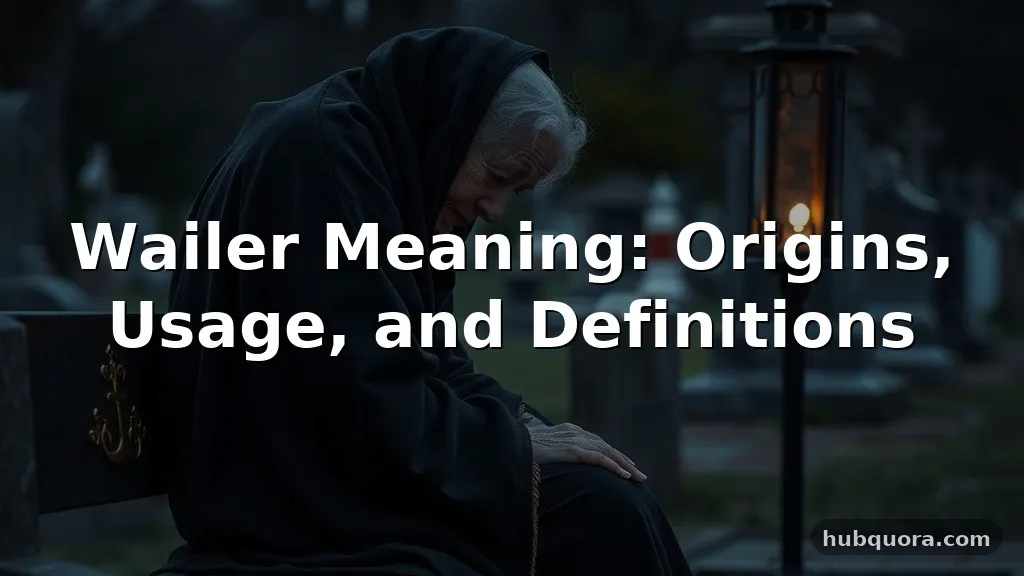
The term wailer carries a weight that reaches far beyond simple dictionary definitions. At its core, the wailer meaning centers on the act of expressing intense emotion, typically through vocalization.
When someone acts as a wailer, they are engaging in a primal, often communal form of expression that has roots in ancient cultural practices. While the modern usage might lean toward musical descriptions or even technical construction jargon, the primary association remains deeply human: the act of someone who expresses grief or pain through long loud sounds.
Understanding this word requires looking at how language evolves from specific, ritualistic actions into broader labels. Whether you are encountering the term in a literary context, a historical account of funeral rites, or a specialized trade environment, the underlying connection to sound and force remains constant.
Historical Roots and the Ritual of Lamentation

The most traditional wailer meaning is linked to the griever lamenter or the mourner sorrower. Historically, this role was not just an individual expression of sadness but a structured, often professional duty.
In many ancient societies, families would employ a hired individual to provide the vocal soundtrack for a funeral. This mourner utters specific sounds to guide the community through the grieving process.
These high-pitched cries served a social function. By externalizing the agony of loss, the lamenter mourner allowed others to feel permission to express their own suppressed emotions.
It is a fascinating aspect of human history where the speaker talker or utterer verbaliser becomes a conduit for collective sorrow. The word you’ll find in historical texts often describes these individuals not merely as sad people, but as figures performing a vital service for the bereaved.
Linguistic Evolution and Modern Vocabulary
Tracing the etymology of the word, we see a clear path from the verb “wail” to the noun “wailer.” The verbalizer of such sounds is someone who gives voice to feelings that words alone cannot capture.
When a wailer performs, the sound is characterized by a long loud resonance that cuts through silence. This is distinct from a sob or a cry; it is a sustained, resonant vocalization.
As the vocabulary of the English language expanded, the term began to bleed into other areas. We see this in how words drift from their original, narrow definition into metaphorical territory. Today, you might hear a musician described as a “wailer” if they play a guitar solo with enough intensity to mimic the human voice.
This shift shows how we borrow from the most visceral human experiences to describe high-intensity performance art. For those interested in the formal evolution of language, Merriam-Webster.com provides a deep dive into the roots of such terms, illustrating how they have transitioned from strictly mournful contexts to broader descriptors of intensity.
Distinguishing Wailers from Whalers
One of the most frequent points of confusion for learners of the English language is the difference between a wailer and a whaler. Despite the phonetic similarity, their meanings are worlds apart.
A whaler is a person who hunts whales, a term rooted in a specific maritime industry. Conversely, a wailer is defined by sound.
This distinction is a classic example of how homophones can lead to misunderstandings. When you see the word in print, the context is your best indicator. If the text discusses harpoons, ships, or the ocean, you are looking at the maritime profession.
If the text discusses music, grief, or the volume of a scream, you are looking at the wailer definition. Recognizing this difference is essential for anyone building their professional or creative vocabulary.
Technical Applications in Construction and Engineering

Moving away from the emotional and historical, the wailer meaning takes on a rigid, structural form in the world of construction. In this context, a wailer—often spelled “waler”—is a horizontal beam used to support vertical forms during concrete pouring. It is a load-bearing element that prevents the forms from bowing under the intense pressure of wet concrete.
This technical usage is quite literal in its function. Just as a human wailer provides a framework for emotional release, a construction wailer provides a framework for structural integrity. It is interesting to note how language often repurposes words for entirely different fields.
In construction, you need log data and precise measurements to ensure the forms wailers are placed correctly. Without these, the entire wall structure could fail, leading to significant site hazards.
The Role of the Mourner in Cultural Traditions
Across various global cultures, the type griever known as the wailer holds a position of profound respect. In many Mediterranean and Middle Eastern traditions, the act of vocalized mourning is a structured performance.
The mourner utters laments that follow specific rhythms or lyrical patterns. This is not random noise; it is a highly skilled art form.
When a wailer participates in a funeral procession, they are helping to manage the psychological state of the attendees. By providing a focal point for the grief, they ensure that the mourning process is active rather than passive. This cultural practice highlights how sound is used to bridge the gap between life and death, creating a sensory experience that defines the communal response to mortality.
Music and the Intensity of Sound
In the realm of music, particularly blues, rock, and jazz, the label “wailer” is high praise. It describes a musician who can coax a long loud and high-pitched sound from their instrument that feels like a cry of the soul.
This is where the talker utterer meets the artist. A guitarist who is considered a “wailer” is someone who can make their instrument sing with the same intensity as a human griever.
The connection here is the raw, unadulterated passion. Musicians who are labeled this way often use bent notes, heavy vibrato, and sustained sustain to create an emotional impact. It is a testament to the power of the word that it has survived centuries of change to remain a relevant descriptor for modern artistic intensity.
Comparison of Contextual Meanings

To better understand how the term functions across different sectors, consider the following table which breaks down the primary ways the word is applied.
| Context | Primary Meaning | Key Characteristic |
|---|---|---|
| Emotional/Ritual | Professional mourner | Vocal lamentation |
| Construction | Support beam (Waler) | Horizontal structural bracing |
| Music/Art | High-intensity performer | Expressive, sustained sound |
This comparison illustrates that while the word sounds the same, the application relies entirely on the environment. Whether you are dealing with a funeral rite, a building site, or a concert hall, the wailer is always a figure of force and significance.
Commonly Confused Terms and Linguistic Nuances
Language is rarely static, and the wailer is often confused with other terms that imply sound or volume. People often ask what the meaning of wailed is compared to simply “crying.”
The distinction lies in the quality of the sound. A wail is specifically a loud, high-pitched vocalization of pain, sorrow, or sometimes anger.
When you see someone described as a “wailer,” you should immediately look for the intensity level. If the person is merely talking or crying softly, the term is being used hyperbolically.
If they are making a sustained, piercing sound that draws attention, the term is being used accurately. Understanding these nuances helps in discerning the tone of a piece of writing.
The “Longest Long” and Linguistic Curiosity
The search for the longest long words or the most unique descriptors often leads people to investigate terms like “wailer.” While it is not a record-breaker in the odyssey’ longest word lists, it is a word that carries significant historical weight. The words odyssey’ of the English language are filled with terms that, like “wailer,” have shifted meanings to survive.
Exploring these terms is a great way to improve one’s grasp of how English functions as a living entity. The save word approach—where we preserve the history of a term while acknowledging its modern use—is the best way to maintain linguistic accuracy. Whether you are a writer, a student, or just a curious reader, understanding the depth behind a simple noun like “wailer” enriches your overall communication skills.
Addressing Topical Gaps and Common Misconceptions
A common gap in existing content about this term is the lack of connection between the human, the musical, and the technical. Most sources treat them as isolated definitions.
However, they are connected by the concept of “forceful expression.” Whether it is a beam holding up a wall or a voice holding up a funeral service, the underlying physics is similar: something is being held or projected with great intensity.
* The term is not exclusively negative.
* It is frequently used in musical critique.
* The spelling “waler” is standard in construction.
* The term implies a sustained, rather than intermittent, sound.
By synthesizing these points, we get a clearer picture of the word. It is a versatile tool in the English language that, when used correctly, adds a layer of visceral detail to any description.
FAQ
What is the most common meaning of wailer?
The most common meaning of wailer refers to an individual who expresses intense grief through loud, high-pitched vocalizations. It is often used in historical or cultural contexts to describe a professional mourner who leads a community in expressing sorrow during funeral rites or periods of collective loss.
Is wailer a synonym for someone who cries?
While related, a wailer is more specific than someone who cries. Crying can be silent or soft, whereas a wailer specifically produces a long, loud, and often high-pitched sound. The term implies a level of intensity and volume that standard crying does not necessarily convey in common usage.
What does wailer mean in construction?
In construction, the term is usually spelled “waler.” It refers to a horizontal support member used in formwork to brace vertical studs or panels. It provides the necessary strength to keep concrete forms from bowing or failing under the high pressure of wet, heavy concrete during a pour.
Can a musician be called a wailer?
Yes, calling a musician a wailer is a common compliment in genres like blues, jazz, and rock. It describes a performer who can produce an incredibly expressive, sustained, and high-intensity sound from their instrument, effectively mimicking the emotional quality of a human voice in a state of deep feeling.

James Wilson is the founder and lead editor of HubQuora.com, where he covers the latest celebrity news, entertainment trends, viral gossip, and net worth stories. With a passion for pop culture and digital media, James delivers engaging, accurate, and up-to-date content that keeps readers informed about the world of celebrities, influencers, and entertainment industry buzz.